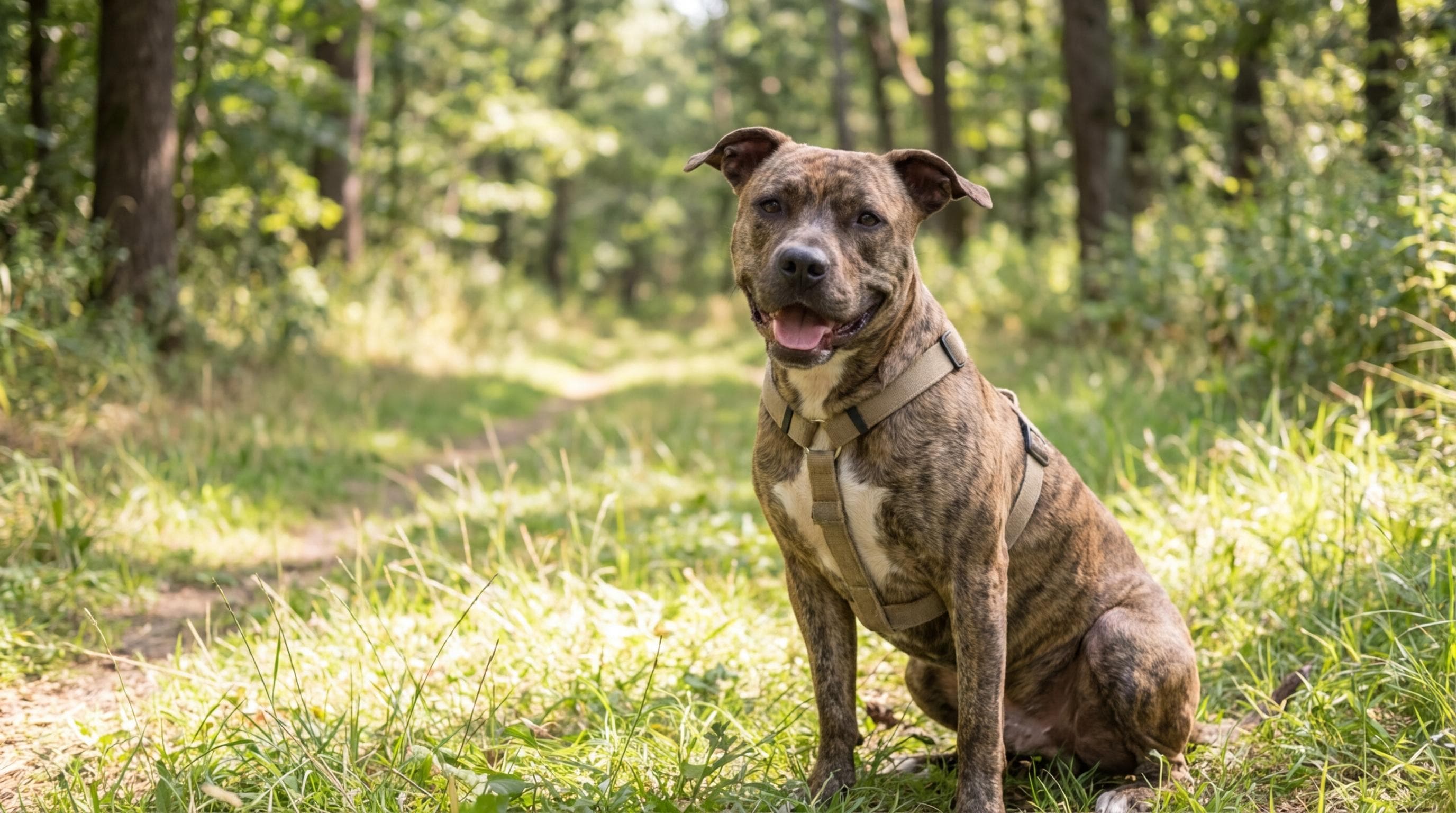
Few dogs carry more baggage than the pit bull. Depending on who you ask, they're either the most loyal and loving family dog on the planet or a ticking time bomb with locking jaws and an insatiable prey drive. Neither portrait is accurate — and the gap between myth and reality has real consequences for millions of dogs who are surrendered, banned, or euthanized every year based on how they look rather than how they behave.
So let's look at what the science actually says.
The Pit Bull Aggression Myth Has Weak Scientific Foundations
The term "pit bull" is itself part of the problem. It doesn't describe a single breed — it's a catch-all label applied to a loosely related group of dogs that share a certain physical appearance: blocky head, muscular build, short coat, wide chest. Shelter workers, animal control officers, and even veterinarians misidentify breeds by appearance at rates exceeding 50 percent in controlled studies. A dog identified as a pit bull at intake has roughly even odds of actually being one.
This matters enormously when evaluating aggression statistics. Bite reports attributed to "pit bulls" almost certainly include American Staffordshire Terriers, Boxers, Bulldogs, American Bulldogs, Mastiff mixes, and dozens of other blocky-headed dogs whose actual genetics are unknown. Studies that rely on visual breed identification, which is most of them, are measuring something closer to "looks like a pit bull" than any actual genetic category.
When researchers account for this identification problem, the data becomes far less alarming. A 2009 study published in the Journal of Veterinary Behavior found no significant difference in aggression between pit bull-type dogs and other large breeds when controlling for owner behavior, socialization history, and training. The breed itself is not a reliable predictor.
Are Pit Bulls Dangerous? The Role of History and Individual Experience
Pit bull-type dogs were historically bred for a practice called bull-baiting and, later, dogfighting. This is where the reputation for danger originates — and where it gets complicated.
Dogfighting selectively bred for two specific traits: willingness to fight other dogs, and a complete absence of human-directed aggression. Dogs who bit their handlers during a fight were culled immediately. The result was a lineage of dogs with potentially high dog-directed aggression and unusually low human-directed aggression — the opposite of the image most people hold.
The American Temperament Test Society has tested thousands of dogs across hundreds of breeds. American Pit Bull Terriers and American Staffordshire Terriers consistently pass at rates comparable to or above Golden Retrievers and Labrador Retrievers. The test isn't without its critics, but the data doesn't support the idea that these dogs have an inherent disposition toward human aggression.
What they do have, like all high-drive dogs, is a set of behavioral tendencies that require informed ownership. Physical strength, high stimulation thresholds, and intense engagement with the environment mean that inadequate socialization and training have steeper consequences than with a lower-drive breed. This is not the same thing as being inherently dangerous.
The Under-Socialized Protector Archetype Explains More Than Breed Ever Could
At Dog Archetype, we've observed that the dogs most commonly labeled dangerous — regardless of breed — tend to share a specific developmental history rather than specific genetics. We call this pattern the Under-Socialized Protector.
Under-Socialized Protectors are dogs who, during the critical socialization window between 3 and 14 weeks, had limited positive exposure to the range of people, animals, environments, and experiences that make an adult dog flexible and confident. The world stayed unfamiliar. And unfamiliar things, to a dog whose nervous system never learned otherwise, are default threats.
These dogs often present as:
- Deeply loyal and affectionate with their immediate family, but stiff or reactive with strangers
- Disproportionately reactive to specific triggers — men in hats, children running, unfamiliar dogs — that weren't normalized early in life
- Slow to deescalate after a perceived threat has passed
- Sometimes described as unpredictable, when the pattern is actually consistent but the triggers aren't obvious to observers
Owner behavior, socioeconomic context, and socialization history collectively predict dangerous dog behavior better than breed in virtually every credible study conducted on the question.
Breed-Specific Legislation Does Not Reduce Pit Bull Bite Rates
If pit bulls were the source of the problem, banning them should make communities safer. The evidence says otherwise.
Aurora, Colorado implemented a pit bull ban in 2005. Bite rates did not decrease. The CDC, the American Veterinary Medical Association, the National Canine Research Council, and the American Veterinary Society of Animal Behavior have all issued statements opposing breed-specific legislation on the grounds that it is ineffective and diverts resources from interventions that actually work.
The interventions that do work focus on what the evidence shows actually causes bites: chained or tethered dogs (who bite at dramatically elevated rates regardless of breed), dogs with histories of neglect or abuse, unaltered males (responsible for a disproportionate share of serious bites), and dogs in homes with inadequate supervision of children.
A dog's history, handling, and environment are not just contributing factors to dangerous behavior. They are the primary factors.
What Actually Predicts Dangerous Dog Behavior in Any Breed
Researchers and veterinary behaviorists consistently identify the same cluster of risk factors across breeds:
Lack of socialization during the critical developmental window creates a nervous system that defaults to fear or aggression when facing the unfamiliar. This is the most preventable cause of dangerous behavior and the one most frequently neglected.
Punishment-based training methods, particularly shock collars, prong corrections, and alpha-roll techniques, reliably increase aggression in already anxious dogs. The AVMA's review of the literature found a direct relationship between the use of confrontational training methods and bite incidents.
Abuse, neglect, and chronic stress produce hyperreactive dogs whose threshold for defensive aggression is dramatically lowered. Dogs who have been hurt by humans protect themselves from humans. This is not complicated — and it is not a breed trait.
Poor owner supervision, particularly involving children, contributes significantly to bite statistics. Most bites occur in contexts where adults were absent and a dog's stress signals were missed or ignored.
None of these risk factors are breed-specific. They apply equally to Labrador Retrievers, Border Collies, and every other dog whose genetics don't appear on a municipal ban list.
How to Work With an Under-Socialized Dog of Any Breed
If you have a pit bull-type dog, or any dog, who fits the Under-Socialized Protector profile, the approach is the same regardless of what they look like.
Start with a thorough assessment from a certified veterinary behaviorist or a trainer with credentials from the International Association of Animal Behavior Consultants. Behavior modification for under-socialized dogs requires a careful understanding of each dog's specific triggers, threshold levels, and history.
Systematic desensitization and counter-conditioning — gradually exposing your dog to their triggers at intensities below their threshold while pairing those triggers with good outcomes — is the evidence-based approach for building the flexibility that didn't develop early in life. This is slow work. It takes months, not weeks. But it works.
Management is not failure. Using a basket muzzle for high-risk situations, controlling your dog's environment, and being honest with yourself about what your dog can and cannot handle safely is responsible ownership, not defeat. Advocacy for your dog means protecting them from situations where they're likely to fail.
For dogs with significant anxiety underlying their reactive behavior, medication as part of a behavior modification protocol consistently improves outcomes. A dog whose nervous system is running at 90 percent capacity cannot learn from training. Bringing that baseline down with appropriate pharmacological support gives the behavior modification room to work.
A More Honest Conversation About Pit Bull Behavior
Pit bulls are not inherently aggressive. They are not uniquely dangerous. They are dogs — shaped by genetics, yes, but shaped far more profoundly by experience, socialization, handling, and the humans who own them.
The dogs most frequently in the news for biting are not representative of the breed. They are representative of what happens when any dog — of any breed — is neglected, under-socialized, abused, or left unsupervised in situations beyond their training. The headline reads "pit bull bites," but the story is almost always something else entirely.
Understanding your dog's behavioral archetype — what drives their behavior, what their history created, and what they need to feel safe — is more useful than any breed label. That's true whether you have a pit bull, a German Shepherd, a Chihuahua, or a Labrador.
Take our free 2-minute Dog Archetype Quiz to discover which behavioral profile fits your dog — and get practical guidance tailored to how they actually think and feel.