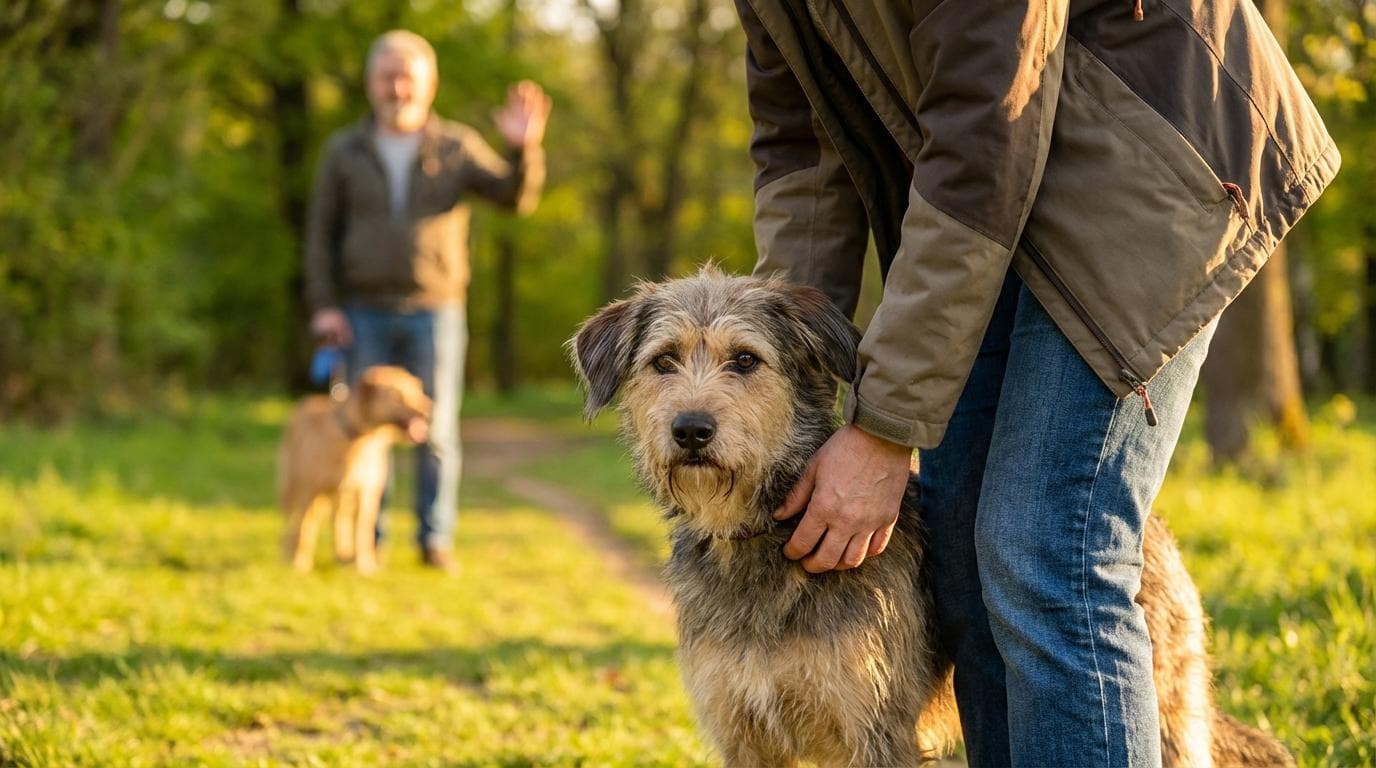
My Dog Is Afraid of Strangers: A Trainer's Guide
If your dog is afraid of strangers, you are not alone. Fear of unfamiliar people is one of the most common behavioral concerns dog owners bring to trainers, and it can range from mild shyness to full-blown panic. Whether your dog hides behind your legs when guests arrive, barks uncontrollably at passersby, or trembles at the sight of someone new, understanding why this happens is the first step toward helping them feel safe. The good news is that with patience, consistency, and the right approach, most dogs can learn to navigate the world of unfamiliar humans with far less stress.
Why Dogs Develop a Fear of Strangers
Fear of strangers in dogs rarely comes from a single cause. It is usually a combination of genetics, early life experiences, and ongoing social exposure. Some breeds are naturally more wary of unfamiliar people, while others may have missed critical socialization windows during puppyhood.
The primary socialization period for dogs falls between roughly 3 and 14 weeks of age. During this time, puppies are primed to accept new experiences, people, sounds, and environments as normal parts of life. Dogs who were not exposed to a wide variety of people during this window often grow up finding strangers inherently alarming. This does not mean your dog is broken or that you failed them. Many rescue dogs, puppy mill survivors, and dogs with unknown histories simply did not get the social exposure they needed during that critical period.
Traumatic experiences also play a role. A dog who was startled, hurt, or overwhelmed by a stranger at any point in their life may generalize that fear to all unfamiliar people. Even a single negative encounter can leave a lasting impression, especially in dogs who are already predisposed to anxiety.
Genetics matter, too. Research published in the journal Scientific Reports has shown that fearfulness in dogs has a significant heritable component. If your dog's parents were nervous around people, your dog may carry that same tendency regardless of how well they were socialized.
Understanding your dog's unique behavioral profile can help you tailor your approach. Dogs who fall into the Fearful Fighter archetype, for instance, tend to react to fear with defensive behaviors like barking, lunging, or growling. These are not signs of aggression in the traditional sense. They are fear-based responses from a dog who feels cornered and is trying to create distance. Discover your dog's archetype to better understand the emotions driving their behavior.
How to Help Your Dog Feel Safe Around New People
The most effective approach for helping a dog who is scared of people is called counter-conditioning paired with desensitization. In plain terms, you are gradually exposing your dog to the thing they fear (strangers) at a level they can handle, while pairing that exposure with something they love (treats, play, calm praise).
Here is how to put this into practice:
- Start at a distance where your dog notices the stranger but is not yet reacting. This might be across the street, across a park, or even watching people through a window. The goal is to keep your dog below their fear threshold.
- The moment your dog looks at the stranger, deliver a high-value treat. Cheese, chicken, freeze-dried liver, or whatever makes your dog's eyes light up. You are building an association: stranger appears, good things happen.
- Gradually decrease the distance over days or weeks, not minutes. Rushing this process is the single most common mistake owners make. If your dog starts barking, freezing, or trying to flee, you have moved too close too fast.
- Never force your dog to interact with someone they are afraid of. Forcing a fearful dog to "say hello" to a stranger is the equivalent of pushing someone with a spider phobia into a room full of tarantulas. It does not build confidence. It destroys trust.
- Ask visitors to ignore your dog completely when they enter your home. No eye contact, no reaching out, no baby talk. Let your dog approach on their own terms. This can take five minutes or five visits, and both timelines are perfectly fine.
- Create a safe retreat space in your home. A crate with a blanket draped over it, a back bedroom, or a spot behind the couch where your dog can observe without being observed. Dogs who have an escape route feel less trapped and are actually more likely to eventually approach.
When to Seek Professional Help
While many cases of stranger fear can be managed at home, some dogs need more support than a training plan alone can provide. Consider reaching out to a certified professional if your dog's fear is escalating rather than improving, if they have bitten or attempted to bite a stranger, if their fear is so severe that it impacts their quality of life (refusing walks, not eating when guests are present, constant trembling), or if you feel unsure about how to read their body language.
Look for a trainer or behavior consultant who uses force-free, science-based methods. Certifications to look for include CPDT-KA, CAAB, or ACVB. Avoid anyone who recommends punishment-based tools like prong collars, shock collars, or "alpha rolls" for a fearful dog. Punishing fear does not eliminate it. It suppresses the warning signs while the fear continues to build underneath, often leading to a dog who bites without warning because their earlier signals were punished out of them.
In some cases, your veterinarian may recommend anti-anxiety medication to take the edge off while behavioral work is underway. Medication is not a failure. It is a tool that can help your dog's brain calm down enough to actually learn from the training you are doing. Think of it as lowering the volume on their fear so they can hear the lesson.
Building Long-Term Confidence
Helping a fearful dog is not a one-time project. It is an ongoing commitment to managing their environment and continuing to build positive associations. Here are some habits that support long-term progress:
- Practice regular, low-pressure socialization. Sit on a bench at a park and let your dog watch people go by from a comfortable distance while you feed treats. No interaction required.
- Celebrate small wins. Your dog glanced at the mail carrier without barking? That is progress. They stayed in the room when your friend sat down? That is huge. Progress with fearful dogs is measured in inches, not miles.
- Keep a log of triggers and reactions. Over time, you will start to see patterns that help you predict and prevent overwhelm before it happens.
- Build their overall confidence through enrichment, puzzle toys, sniff walks, and trick training. A dog who feels capable in general is more resilient when facing their specific fears.
- Be their advocate. It is okay to tell people "please do not pet my dog" or to cross the street to avoid a crowded sidewalk. Protecting your dog's emotional boundaries is not being difficult. It is being a responsible owner.
If you are curious about what drives your dog's specific fears and behaviors, understanding their behavioral archetype can give you a powerful framework for tailoring your approach. Take the quiz to discover whether your dog is a Fearful Fighter, an Anxious Guardian, or one of the other archetypes, and get personalized guidance for helping them thrive.
Further Reading
- Fear of People in Dogs - ASPCA
- Desensitization and Counter-Conditioning - American Kennel Club