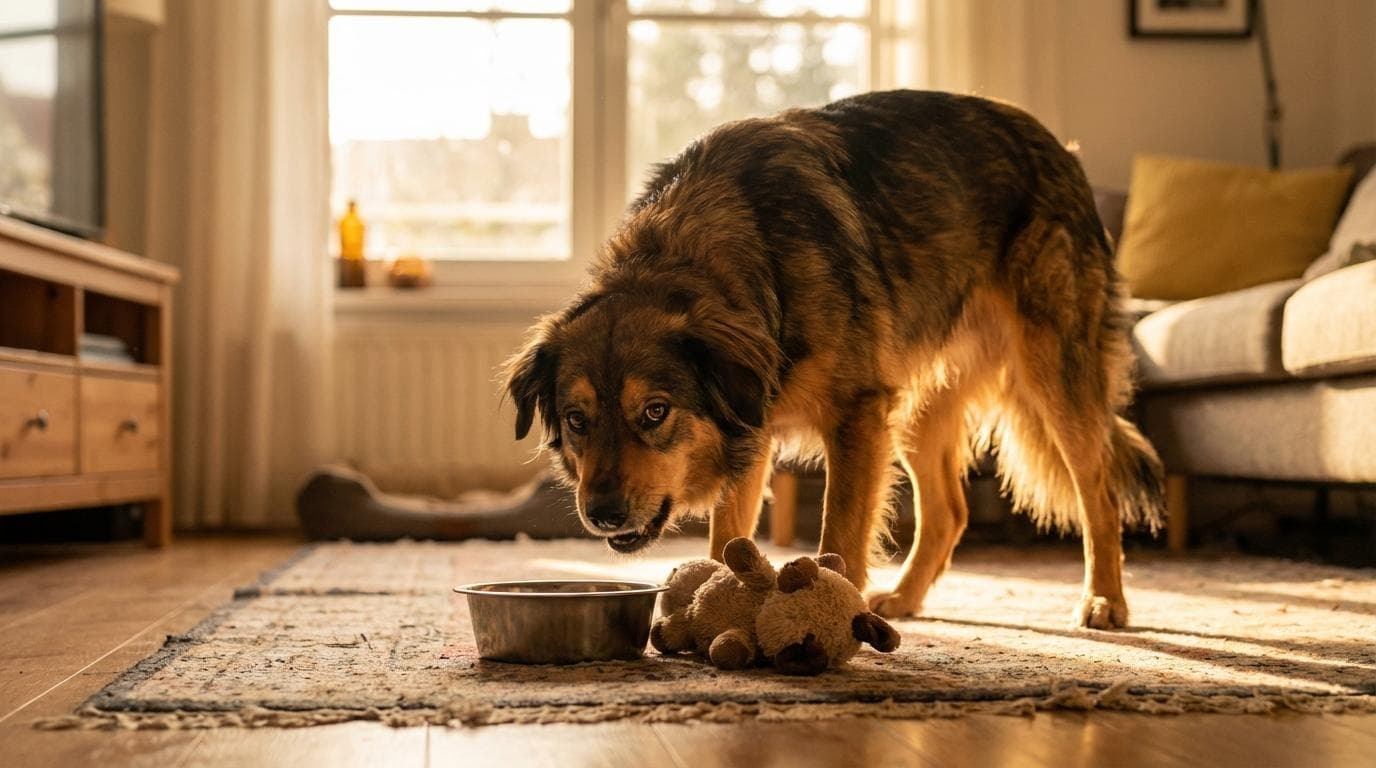
Your dog growls when you walk past their food bowl. They stiffen when you reach for the toy they're chewing. They snap when another dog approaches their favorite resting spot. You've been told this is "dominance" and you need to show them who's boss by taking their food away, eating before them, or physically correcting the behavior.
That advice is not just wrong — it's dangerous. Resource guarding is a normal, evolutionarily adaptive behavior that exists on a spectrum. Every dog has some degree of it. The question isn't whether your dog guards resources, but whether the guarding has escalated to a level that creates risk, and whether your response is making it better or worse.
What Resource Guarding Actually Is
Resource guarding is any behavior a dog uses to maintain control of something they value. That can include food, toys, chews, resting spots, people, or even abstract things like access to doorways or the car. The behavior ranges from subtle — eating faster when you approach, moving a toy to the other side of the room — to overt — growling, snarling, snapping, or biting.
In the wild, guarding resources is survival. A wolf who doesn't protect their food from other pack members doesn't eat. The instinct is hardwired, and while domestication has softened it in many dogs, it hasn't eliminated it. Some breeds and some individual dogs carry stronger guarding tendencies than others.
Dogs with the Territorial Protector behavioral archetype often display resource guarding as part of a broader pattern of controlling their environment. For these dogs, guarding isn't just about the specific item — it's about maintaining order and security in their perceived domain.
The Spectrum of Resource Guarding
Understanding where your dog falls on the guarding spectrum helps you calibrate your response.
Mild Guarding (Normal)
- Eating faster when someone approaches
- Carrying a toy to another room
- Turning their body to block access to an item
- Mild stiffening when touched while eating
Moderate Guarding (Needs Management)
- Hard stare when approached with a valued item
- Low growling over food or toys
- Freezing when someone reaches toward their item
- Showing whale eye (whites of eyes visible)
Severe Guarding (Needs Professional Help)
- Snapping or air-biting when someone approaches
- Biting when items are taken away
- Lunging at people or dogs who come near resources
- Guarding expanding to more items or spaces
Why Confrontational Approaches Backfire
The old-school advice — take the food bowl away while the dog is eating, make the dog wait while you eat first, physically remove items — is based on the debunked "dominance theory" and reliably makes resource guarding worse.
Here's why: from the dog's perspective, approaching and taking their food confirms their fear. They were worried someone would take their stuff, and then someone did exactly that. The rational response, from the dog's viewpoint, is to guard harder next time. The growl that didn't work becomes a snap. The snap becomes a bite. You've escalated the exact behavior you were trying to fix.
Research by Dr. Meghan Herron at Ohio State University found that confrontational techniques — alpha rolls, staring down, grabbing the dog — were associated with significantly higher rates of aggressive responses. Dogs who were confronted over resource guarding were more likely to bite than dogs whose guarding was addressed through positive approaches.
How to Reduce Resource Guarding Safely
Step 1: Management First
Before you train, you manage. The goal is to prevent the guarding behavior from being rehearsed while you work on changing the underlying emotional response.
- Feed your dog in a low-traffic area where no one will approach
- Don't take things away from your dog unless there's a safety emergency
- Provide high-value chews only when the dog can enjoy them without interruption
- If you have multiple dogs, feed them separately
Step 2: Change the Emotional Response
The core technique is trading up. Approach your dog while they have a low-value item and offer something better. Drop a piece of chicken near their food bowl as you walk past. Offer a high-value treat in exchange for a toy. The dog learns that people approaching their stuff predicts something even better arriving — not something being taken away.
Start at a distance where your dog shows zero guarding behavior. If they stiffen when you're five feet from their bowl, start at eight feet. Toss the treat from that distance. Gradually decrease the distance over days or weeks as your dog's comfort level increases.
Step 3: Teach "Drop It" and "Leave It"
These are trained separately from guarding situations, starting with items the dog doesn't care about. Present a boring item, say "drop it," and offer something wonderful in exchange. The dog learns that releasing an item on cue always results in something better. Once the behavior is fluent with low-value items, gradually increase the value of the items being dropped.
Never practice "drop it" during a live guarding episode. If your dog is growling over a stolen sock, use management — lure them away with something better rather than confronting the guard.
Step 4: Build Positive Associations
Make your presence near your dog's resources consistently positive. Walk past the food bowl and drop treats into it. Approach your dog while they're chewing and offer an additional chew. Sit near your dog's bed and scatter treats around it.
Over time, your approach should predict good things so reliably that your dog relaxes rather than tenses when they see you coming. This is counter-conditioning — changing the emotional response from "threat incoming" to "good things incoming."
Resource Guarding Between Dogs
Dog-to-dog resource guarding follows the same principles but requires additional management. In multi-dog households:
- Feed dogs in separate rooms with closed doors
- Provide enough high-value resources that competition is unnecessary
- Don't leave coveted items out when dogs are together unsupervised
- Intervene early at the stiffening stage rather than waiting for escalation
When Professional Help Is Essential
If your dog has bitten over resources, if the guarding is escalating despite your management efforts, or if children are in the household and your dog guards from people, consult a certified veterinary behaviorist or a certified professional dog trainer who specializes in aggression cases. This is not a DIY situation once biting is involved.
Resource guarding that appears suddenly in an adult dog who never guarded before can also signal pain. A dog who is hurting may guard their body or their resting spot because being touched or moved causes discomfort. Rule out medical causes before committing to a behavioral plan.
Resource guarding is almost always part of a larger behavioral pattern. Take the free Dog Archetype Quiz to understand your dog's complete behavioral profile and learn how guarding fits into their overall approach to the world.