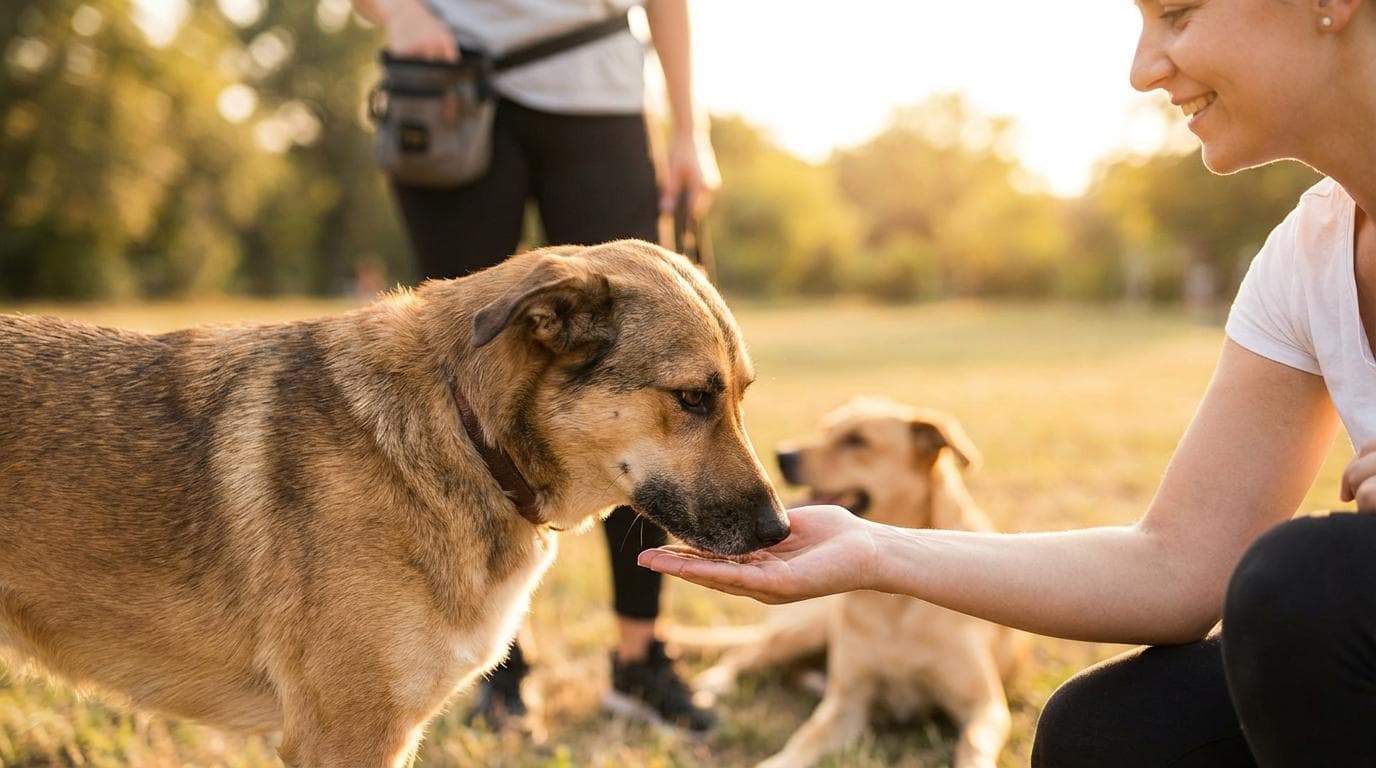
You adopted a rescue dog who freezes when strangers approach. Or you raised a puppy who somehow missed the socialization window and now growls at unfamiliar dogs on the street. Or your dog is fine at home but falls apart the moment they leave their familiar environment — barking, cowering, lunging, or shutting down entirely.
If any of that sounds familiar, you're likely dealing with an under-socialized dog. The good news: under-socialization is not a permanent condition. It is a gap in experience, not a flaw in your dog's character. With the right approach — patient, structured, and always guided by your dog's comfort level — most under-socialized dogs make significant progress.
The bad news is that the instinct to "just expose them to more stuff" can actively make things worse. This article explains what under-socialization actually is, why the Under-Socialized Protector archetype behaves the way they do, and the specific steps that produce real improvement.
What Under-Socialization Actually Means
Socialization is the process by which a young dog learns what is normal and safe in the world. During a critical developmental window — roughly 3 to 16 weeks of age — a puppy's brain is primed to absorb new experiences and form lasting associations. Encounters with different people, animals, surfaces, sounds, and environments during this window create a mental template of "this is how the world works, and it is generally safe."
When that window closes without sufficient positive exposure, the dog's default response to novelty shifts from curiosity to caution. The world did not teach them that strangers are usually fine, that other dogs are often friendly, that traffic noise is just background. So their nervous system treats the unfamiliar as a potential threat, and their behavior reflects that vigilance.
Under-socialization is extremely common in rescue dogs, dogs raised in rural or isolated environments, dogs who were ill during the critical window and couldn't be exposed safely, and dogs from breeders who kept litters in limited environments. It is not the owner's fault. It is a circumstance of the dog's early life.
The Under-Socialized Protector: Why They Do What They Do
The Under-Socialized Protector is a dog whose guarding or reactive behaviors are driven primarily by insufficient early experience rather than genetics or trauma. When they encounter something unfamiliar — a stranger, a new dog, an unexpected environment — their brain has no established template that says "this is normal." In the absence of that template, their instinctive response is to treat the unfamiliar as a potential threat.
This often looks protective or territorial on the outside: barking at visitors, lunging at dogs they haven't met, freezing or pulling away in new environments. But the underlying driver is closer to anxiety than aggression. They are not trying to dominate the situation. They are trying to manage something that feels genuinely overwhelming because they have never learned to find it manageable.
Two common patterns emerge in Under-Socialized Protectors:
The Defensive Reactor signals their discomfort loudly — barking, growling, lunging, posturing. These dogs look aggressive but are primarily trying to create distance. Their behavior works: the unfamiliar thing usually retreats, which reinforces the strategy.
The Shutdown Dog goes quiet and still instead. They stop moving, stop engaging, may refuse food or commands. This looks calmer but is equally stressed — it's a freeze response, not comfort. These dogs are sometimes incorrectly assessed as "fine" in new environments because they don't create a scene.
Both patterns require the same basic intervention: controlled, gradual, positive exposure that builds a new template.
The Core Principle: Below Threshold, Always
The single most important concept in socializing an under-socialized dog is the threshold.
Your dog's threshold is the point at which they shift from noticing a trigger to reacting to it. Above threshold, they are in a stress response: their brain is flooded with cortisol, their capacity to learn shuts down, and every moment spent in that state reinforces the neural pathway that says "this thing is dangerous." Below threshold, they can notice the trigger, acknowledge it, and — with guidance — form a new association with it.
This means that all effective work with an under-socialized dog happens at distances and intensities where they can see or notice the trigger without reacting. For some dogs, that means working at 50 feet from a stranger. For others, it means being in a parking lot where a dog is visible but not audible. You find the distance that works and you start there — not at the distance that would be convenient for you, but at the distance that allows your dog to remain calm.
How to Socialize an Under-Socialized Dog: A Practical Framework
Start with a Behavioral Inventory
Before you begin any exposure work, get specific about what your dog finds difficult. Not just "strangers" but: strangers who make eye contact vs. strangers who ignore them, men vs. women, people in hats, people who move quickly, people who crouch down. Not just "other dogs" but: large dogs vs. small dogs, dogs who approach directly vs. dogs who are stationary.
The more specific your inventory, the more targeted your exposure plan can be. A dog who is fine with women but anxious around men needs a different approach than a dog who finds all strangers equally overwhelming.
Use Counter-Conditioning as Your Primary Tool
Counter-conditioning means pairing the scary thing with something your dog genuinely loves — typically a high-value food. The mechanics are simple: the trigger appears, the food appears. The trigger disappears, the food disappears. Over many repetitions, the dog's brain begins to associate the trigger with the food rather than with threat.
For this to work:
The trigger must appear before the food. If you see a stranger approaching, you start delivering treats the moment your dog notices them — not after they start reacting.
The trigger must be below threshold. If your dog is already reacting, they are above threshold and counter-conditioning is not happening. Increase the distance and try again.
The food must be genuinely high-value. Kibble is not high-value for most dogs in a stressful context. Chicken, cheese, hot dogs, or whatever your specific dog goes genuinely enthusiastic about — that is what you need for this work.
Consistency matters more than session length. Five minutes of well-managed exposure three times a week produces more progress than one overwhelming hour on the weekend.
Introduce Controlled Dog-to-Dog Exposure
For dogs who are reactive or fearful around other dogs, parallel walking is one of the most effective early steps. Two dogs walk on parallel paths, far enough apart that neither is reacting, in the same direction. They are in proximity but not interacting. Over multiple sessions, the distance gradually decreases.
Parallel walking works because it allows dogs to acclimate to each other's presence without the pressure of direct interaction. Head-on greetings, face-to-face approaches, and dogs who rush toward each other are all high-pressure scenarios that under-socialized dogs find overwhelming. Parallel walking takes the pressure off while still building positive association.
When your dog can walk at close range to a known, calm dog without reacting, brief, controlled sniff introductions become possible. Keep them short. Let your dog disengage if they want to. Do not force continued interaction when your dog is signaling that they've had enough.
Build Positive Stranger Associations
The goal is not to get your dog to like strangers. The goal is to get your dog to feel neutral about strangers — to have enough positive history with new people that they don't automatically treat unfamiliar humans as threats.
Start with strangers who are easy: people who ignore your dog, who stand sideways rather than approaching directly, who don't make eye contact. Have those people toss high-value treats onto the ground near your dog without making it a social interaction. The dog learns: when a new person appears, food happens. The new person doesn't need to do anything else.
As your dog's response improves, you can introduce more direct interaction — but always at your dog's pace. A dog who moves toward a stranger on their own initiative is making real progress. A dog who is pushed toward a stranger and tolerates it is not.
Manage the Environment, Not Just the Training Sessions
Socialization work happens during dedicated training sessions, but your dog's environment affects their progress around the clock. An under-socialized dog who is constantly exposed to triggers above their threshold — because their daily walks take them through a busy area, because guests arrive without warning, because they're taken to dog parks before they're ready — is spending most of their time in a stress state.
Stress hormones take time to metabolize. A dog who is frequently over-threshold is running on a high cortisol baseline, which means their threshold for reactivity is lower than it would otherwise be. Managing their environment to reduce incidental over-threshold exposures during the training period is not avoidance — it's protecting the progress you're making.
What Not to Do
Do not use punishment or corrections during exposure work. Punishing a dog who barks at a stranger tells them nothing about how to feel safer around strangers. It adds an additional aversive to an already stressful context and typically makes the anxiety worse, not better.
Do not flood. Flooding means prolonged exposure to a high-intensity trigger in hopes the dog will habituate. Sometimes it works. Often it doesn't — and when it doesn't, you've significantly deepened the fear response and eroded the trust your dog has in you to protect them from overwhelming experiences.
Do not set timelines. Under-socialized adult dogs can make remarkable progress, but the timeline depends entirely on the individual dog, the consistency of the work, and how significant the socialization gap was. Pressure to progress faster than your dog is ready for produces setbacks, not shortcuts.
When to Bring in Professional Support
If your dog's reactivity is intense, if there has been a bite history, or if you've been working consistently for several months without meaningful progress, a certified professional is worth consulting. A certified applied animal behaviorist or a veterinary behaviorist can assess whether anxiety medication would be appropriate — not as a permanent solution, but as a tool to lower the baseline enough for behavior modification to take hold.
Medication doesn't change behavior directly. It changes the dog's capacity to engage with behavior modification by reducing the intensity of their anxiety response. For dogs whose reactivity is driven by significant anxiety, it can be the difference between a dog who is theoretically in training and a dog who is actually learning.
Take our free 2-minute Dog Archetype Quiz to find out if your dog matches the Under-Socialized Protector profile — and get tailored guidance on helping them build confidence at their own pace.