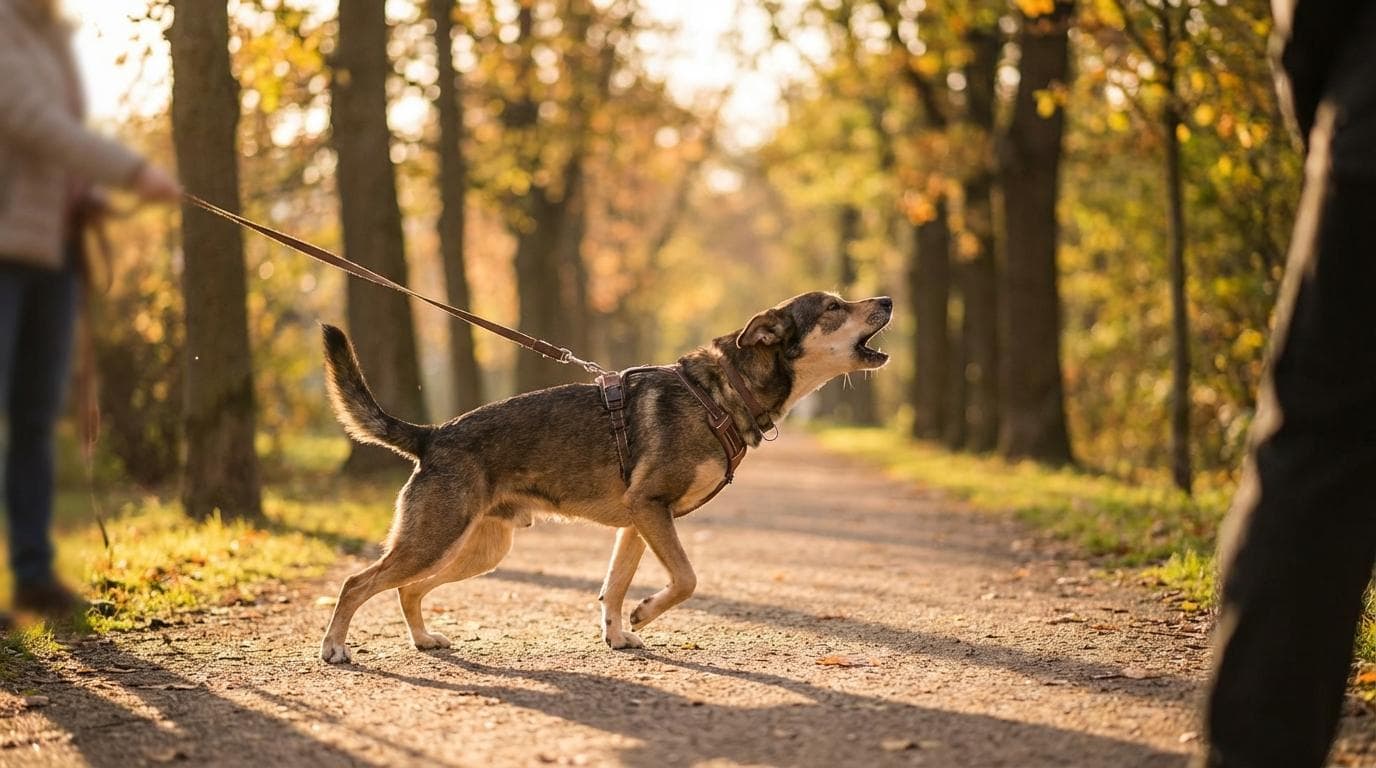
You've hired a trainer. You've watched every YouTube video. You carry treats on every walk, cross the street to avoid other dogs, and still — your dog explodes the moment they see another dog or person. The barking, the lunging, the embarrassment, the white-knuckle grip on the leash. It hasn't gotten better. In some ways, it's gotten worse.
Leash reactivity is one of the most frustrating behavior problems in dog ownership because the obvious solutions — redirecting, avoiding, correcting — address the surface behavior while the root causes continue operating underneath. Until you identify and address what's actually driving the reactivity, you'll be managing symptoms indefinitely.
Here are five causes of leash reactivity that most training approaches miss entirely.
1. Chronic Stress Accumulation (Trigger Stacking)
Your dog doesn't start each walk at zero. They carry a stress load from everything else in their life — the construction noise that morning, the delivery driver who rang the doorbell, the squirrel they saw through the window, the argument they overheard in the kitchen. Each stressor adds to their total arousal level, even if none of them individually seems significant.
By the time you hit the sidewalk, your dog may already be at 70% of their stress capacity. The dog across the street that they'd normally handle at 30% arousal now pushes them over threshold because they were already loaded. This is trigger stacking, and it explains why your dog is reactive some days and fine on others.
The fix isn't just about the walk — it's about reducing the total stress load across your dog's entire day. Environmental management at home, adequate rest, predictable routines, and decompression time between stimulating activities all reduce the baseline arousal your dog carries into their walks.
2. Leash Tension Creates a Feedback Loop
The leash itself contributes to reactivity in ways most owners don't realize. When your dog sees a trigger, your first instinct is to tighten the leash. That tension communicates directly to your dog through physical pressure: it says "something is wrong" and "you can't escape." Both messages increase arousal.
Simultaneously, your own body language changes. You tense your shoulders, hold your breath, grip harder — all signals that your dog reads as confirmation that the approaching trigger really is dangerous. Your dog's stress increases your stress, which increases your dog's stress. The feedback loop is physical and emotional, operating through the leash like a telegraph wire.
Learning to keep a loose leash during trigger encounters is extraordinarily difficult but transformatively important. Using a longer leash (6 feet, not 4) and practicing relaxing your grip when you see a trigger — rather than tightening — can meaningfully reduce your dog's reactivity by removing one of the amplifying factors.
3. Frustration from Restricted Social Access
Not all leash reactivity is fear-based. Some dogs react because they desperately want to interact with the trigger and can't. These are dogs who are social, enthusiastic, and lack impulse control — and the leash frustrates their desire for contact so intensely that the frustration explodes as barking and lunging.
The tell is in the body language. A frustrated-reactive dog often has loose, wiggly body language between outbursts. Their tail wags. They whine as much as they bark. They pull toward the trigger rather than away from it. If the leash were removed, many of these dogs would run up and attempt to play (often rudely, but without aggression).
Standard counter-conditioning protocols designed for fearful dogs don't work well for frustrated reactors because the emotional state is different. The frustrated dog doesn't need to learn that triggers are safe — they already think triggers are wonderful. They need impulse control: the ability to want something and tolerate not getting it immediately.
4. Lack of Decompression and Sniffing Time
Walks that are structured entirely around human goals — covering distance, maintaining heel position, keeping pace — deprive dogs of their primary method of processing the environment: their nose. A dog who is walked briskly at heel for 30 minutes has exercised their body but barely engaged their brain. Their sensory processing needs are unmet, and the resulting cognitive frustration contributes to reactivity.
Decompression walks — loose-leash walks in low-traffic areas where the dog is allowed to sniff freely, change direction, and explore at their own pace — are one of the most underrated tools for reducing reactivity. Sniffing lowers heart rate, activates the parasympathetic nervous system, and provides the mental processing time that structured walks deny.
If every walk your dog takes is through a busy neighborhood at a brisk pace, their stress never fully resolves between walks. Adding even two decompression walks per week in a quiet park or trail can measurably reduce baseline reactivity on their regular routes.
5. Pain or Physical Discomfort
This is the cause that almost everyone overlooks. A dog who is in pain has a lower threshold for reactivity because their coping resources are already depleted by managing discomfort. Arthritis, hip dysplasia, neck pain, dental issues, ear infections, and gastrointestinal discomfort can all contribute to increased reactivity.
The connection isn't always obvious. A dog with hip pain might not limp, but they might react more intensely to approaching dogs because they can't physically move away quickly if needed, making them feel more trapped and vulnerable. A dog with neck pain might react more when wearing a collar because the pressure on their neck during a reactive episode increases their pain, which increases their stress, which increases their reactivity.
If your dog's reactivity has worsened without a clear behavioral explanation, if it appeared suddenly in an adult dog, or if it's accompanied by any changes in gait, posture, appetite, or sleep, get a thorough veterinary exam — including orthopedic assessment — before committing to a behavioral plan.
A Framework That Addresses All Five
Effective leash reactivity management addresses all of these factors simultaneously:
- Reduce total stress load: Manage the home environment, establish predictable routines, provide adequate rest
- Break the leash tension loop: Use appropriate equipment, practice handler relaxation, maintain distance
- Build impulse control: Train "wait," "leave it," and "look at me" in non-reactive contexts first
- Add decompression: Include sniff walks and low-stimulation outings in the weekly routine
- Rule out pain: Get a veterinary assessment, especially if reactivity has changed or worsened
Leash reactivity is almost always part of a broader behavioral pattern. Take the free Dog Archetype Quiz to identify your dog's archetype and understand how the five hidden causes apply specifically to your dog's behavioral profile.