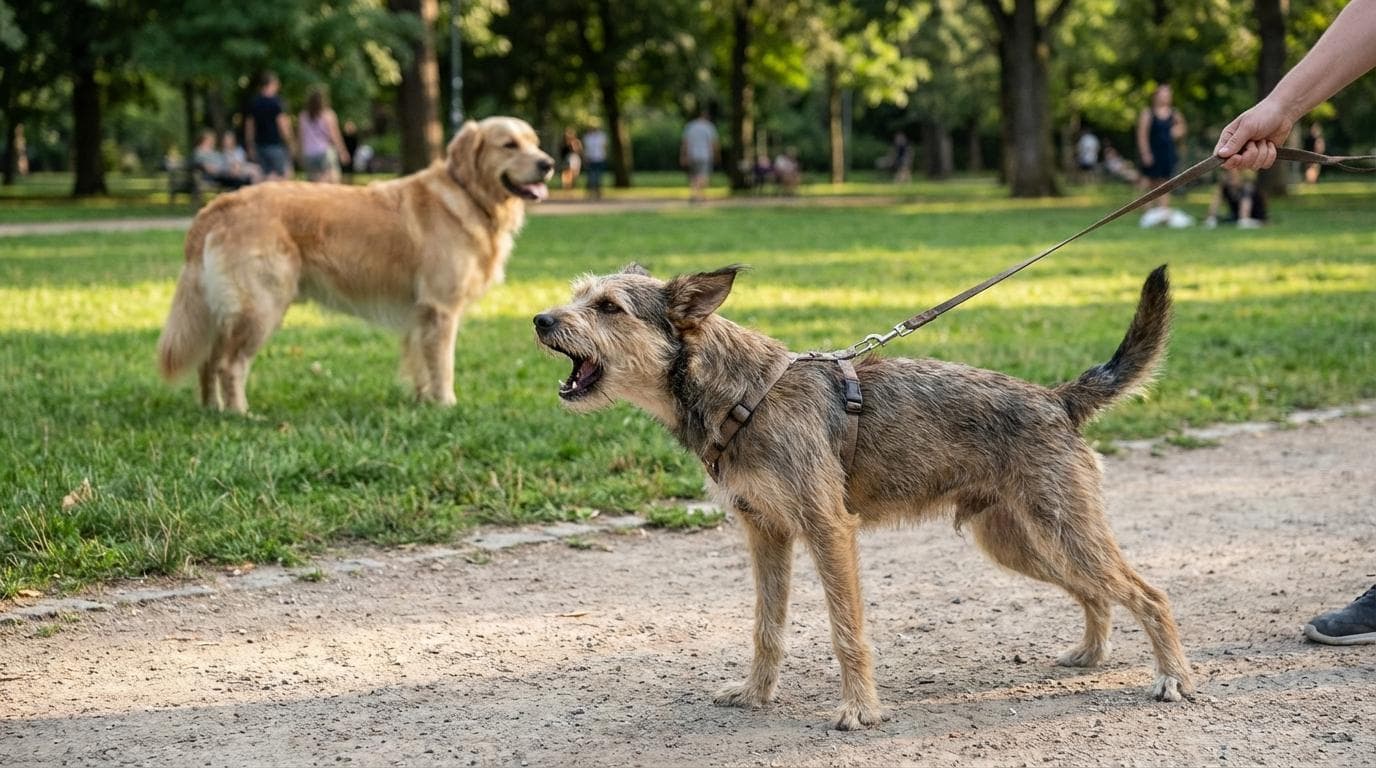
It’s a scenario many dog owners know all too well: you’re enjoying a walk with your beloved companion, perhaps admiring the scenery, when suddenly, another dog appears. Before you can even react, your dog launches into a frenzy of barks, lunges, and pulls, turning your serene stroll into a scene of utter chaos. The embarrassment, the frustration, the feeling of helplessness – it’s overwhelming. You love your dog, but these outbursts can make you dread walks and question what you’re doing wrong.
If you’re struggling with a dog that barks at other dogs, you are not alone. This is one of the most common and challenging behavioral issues dog owners face. But here’s the crucial truth: your dog isn’t barking to be naughty or to spite you. Barking is a form of communication, and when your dog barks at other dogs, they are trying to tell you something important about how they feel and what they need in that moment. Understanding why your dog reacts this way is the first, most critical step toward helping them feel more comfortable and achieving quieter, more enjoyable walks for both of you.
Why Your Dog Barks at Other Dogs: Deciphering the Message
When your dog barks at other dogs, they’re not just making noise; they’re expressing a complex range of emotions and intentions. Pinpointing the exact reason is key to finding the right solution. Let's explore the most common motivations behind this behavior.
Fear and Anxiety: The "Keep Away" Bark
One of the most frequent reasons a dog barks at other dogs is fear or anxiety. Imagine feeling threatened and wanting someone to leave you alone – barking can be your dog's way of saying, "Stay away!" This isn’t aggression in the traditional sense, but rather a defensive strategy. Your dog might feel vulnerable, overwhelmed, or simply unsure of how to interact.
You might notice body language cues like a tucked tail, flattened ears, lip licking, yawning, or turning their head away, often followed by a stiff posture, raised hackles, and intense barking and lunging. They’re trying to create distance. This is characteristic of a "Fearful Reactor" archetype, a dog whose primary response to perceived threats or novel stimuli is to retreat or defensively lash out. They're often sensitive to their environment and can be easily overwhelmed by new experiences or unfamiliar dogs.
Frustration: "I Want To Say Hello (But I Can't!)"
Sometimes, the barking comes from a place of intense desire to interact, but an inability to do so. This is often called "frustrated greeting." Your dog might desperately want to play or sniff the other dog, but being held back by the leash, or sensing that interaction isn't possible, leads to an outburst of frustration. It’s like a child throwing a tantrum because they can’t have the toy they want.
These dogs often have loose, wiggly body language initially, pulling hard on the leash towards the other dog, with an excited, high-pitched bark. When they realize they can't get what they want, the barking intensifies, sometimes accompanied by jumping and pulling. This is a hallmark trait of the "Frustrated Greeter" archetype, a dog who genuinely wants to engage but struggles with impulse control and managing their excitement when their desires are thwarted.
Over-excitement and Over-stimulation: Too Much, Too Fast
Some dogs are simply wired for high energy and get easily over-stimulated by their environment. The sight of another dog, combined with the sounds, smells, and the general hustle and bustle of a walk, can push them over their sensory threshold. They might not be fearful or frustrated, but rather just unable to process all the incoming information calmly. The barking is a release of this pent-up, over-the-top energy.
You might see frantic pulling, jumping, and a continuous string of barks, often without any clear aggressive intent. These dogs often struggle with self-regulation and can find it hard to settle down once they’re revved up. This behavior is common in the "Overstimulated Athlete" archetype, a dog with boundless energy and a high drive who needs structured outlets for their physical and mental prowess.
Territoriality or Protection: Guarding Their Space (and You)
For some dogs, barking at other dogs is about defending what they perceive as their territory or protecting their human. This might be more pronounced in certain areas, like near your home, or if another dog gets too close to you. They see the approaching dog as an intruder or a threat to their pack.
Body language for territorial barking might include a stiff posture, ears forward, a direct stare, and a deep, assertive bark. They might position themselves between you and the other dog. This behavior is often seen in the "Anxious Guardian" and "Under-socialized Protector" archetypes. The Anxious Guardian is driven by a deep-seated need to protect their family and territory, often stemming from underlying anxiety, while the Under-socialized Protector might lack the social skills to interpret or engage with other dogs appropriately, leading them to resort to defensive displays.
Lack of Social Skills: "I Don't Know How to Dog"
Just like people, dogs need to learn appropriate social etiquette. If a dog had limited positive exposure to other dogs during their critical developmental periods (especially between 3 and 16 weeks of age), they might simply lack the skills to interact politely. Barking can be their clumsy, albeit loud, attempt to communicate or simply an expression of confusion.
They might bark out of uncertainty, not knowing how to initiate play or greeting, leading to an awkward, often boisterous display. This is a common characteristic of the "Under-socialized Protector" archetype, where limited positive experiences with other dogs can lead to a lack of confidence and appropriate social responses.
Decoding Your Dog's Barking on Walks
When your dog is barking on walks, every detail matters. Observe not just the barking, but the entire context.
* Body Language: What is your dog’s tail doing? Is it tucked, wagging loosely, or held stiffly? Are their ears back, forward, or relaxed? What about their mouth – tight, panting, lip-licking? Is their body stiff or loose? Are their hackles raised?
* Distance Threshold: At what distance does your dog start reacting? Is it when another dog is across the street, or only when they’re within a few feet? This "threshold" is crucial. Knowing it allows you to manage situations effectively.
* Trigger Specificity: Does your dog bark at all dogs, or only certain types (e.g., big dogs, small dogs, dogs of a specific breed or color)? Does it happen more often with fast-moving dogs, or dogs that stare?
* Your Behavior: How do you react? Do you tense up, pull the leash, or try to soothe them? Your own anxiety can inadvertently contribute to your dog's reaction.
Understanding these nuances helps you piece together the puzzle of why your dog barks at other dogs and guides you toward the most effective strategies to stop dog barking at dogs.
Practical Strategies to Stop Dog Barking at Dogs
Addressing reactive dog barking requires patience, consistency, and a multi-faceted approach. There’s no magic bullet, but with the right techniques, you can help your dog learn to cope more calmly.
1. Management: Preventing Rehearsal of the Behavior
The first and most immediate step is to manage your dog's environment to prevent them from practicing the unwanted behavior. Every time your dog barks and lunges, the behavior becomes more ingrained.
* Avoid Triggers: If you know certain routes or times are particularly busy, change your walking schedule or location. Walk during off-peak hours, choose quiet parks, or explore less-trafficked trails.
* Increase Distance: If you see another dog approaching, cross the street, turn around, or step behind a parked car or bush. The goal is to keep your dog below their reaction threshold.
* Use a Head Halter or Front-Clip Harness: These tools can give you more control, making it easier to redirect your dog without causing pain or discomfort. Avoid retractable leashes, which offer little control and can be dangerous.
2. Desensitization and Counter-Conditioning: Changing the Emotional Response
This is the cornerstone of training for reactive dog barking. It involves gradually exposing your dog to their triggers at a distance where they remain calm, while simultaneously creating a positive association.
* Find Their Threshold: Start by identifying the maximum distance at which your dog can see another dog without reacting. This is your starting point.
The "Look At That" Game (LAT): When your dog sees another dog at a distance where they are calm (below threshold), mark the sight with a clicker or a verbal marker like "yes!" and immediately give them a high-value treat. The goal is for your dog to see another dog, look at it, then voluntarily look back at you* for a treat, associating other dogs with good things.
* Gradual Approach: Over time, as your dog consistently remains calm and looks back at you, you can gradually decrease the distance to other dogs. This process takes time and should never be rushed. If your dog reacts, you've gone too far too fast – increase the distance again.
3. Engage and Redirect: Focus on You
Teach your dog that you are the most interesting thing on a walk, even when other dogs are around.
* High-Value Rewards: Use treats your dog absolutely loves (e.g., cheese, cooked chicken, hot dogs) to capture their attention.
* Focus Exercises: Practice "watch me" or "touch" commands in low-distraction environments, then gradually introduce them to more stimulating settings. When another dog appears at a safe distance, ask for one of these behaviors and reward heavily.
* "Find It" Game: When you see another dog approaching, toss a handful of treats on the ground for your dog to sniff out. This engages their nose, which is calming, and redirects their attention away from the trigger.
4. Teach an Alternative Behavior: "What to Do Instead"
Instead of barking, what do you want your dog to do?
* "Heel" or "Side": Train your dog to walk calmly by your side, even when distractions are present. Reward heavily for maintaining position.
* "Sit" or "Down": Ask for a sit or down-stay as another dog passes at a distance. Reward for maintaining the position calmly.
5. Be Your Dog's Advocate: Protecting Their Space
Don't be afraid to create space for your dog. It's okay to tell other owners, "My dog needs space," or "We're in training." Your dog relies on you to manage their environment and keep them safe and comfortable.
6. Consider Professional Help
If you've tried these strategies consistently for several weeks and are still struggling, or if your dog's barking is escalating, it's time to seek help from a certified professional dog trainer or behaviorist. They can observe your dog in person, identify specific triggers, and develop a personalized training plan. They can also help rule out any underlying medical issues that might contribute to reactivity.
Understanding Your Dog's Archetype for Personalized Solutions
Every dog is an individual, and while the general principles of training remain constant, the nuances of your approach should be tailored to your dog’s unique personality and motivations. This is where understanding your dog's behavioral archetype becomes incredibly valuable.
For example, a "Fearful Reactor" will need a heavy emphasis on building confidence and positive associations from a safe distance, slowly expanding their comfort zone. A "Frustrated Greeter" might benefit more from impulse control exercises, teaching them that calm waiting leads to rewards (or even controlled greetings, if appropriate). An "Overstimulated Athlete" needs ample physical and mental exercise before walks, along with structured focus work to help them manage their excitement. An "Anxious Guardian" or "Under-socialized Protector" will require a focus on building trust, clear communication, and careful, positive socialization experiences.
Knowing your dog's primary archetype helps you understand the root cause of their barking and allows you to implement strategies that truly resonate with their innate drives and challenges, making your training efforts far more effective and leading to lasting change.
A Path to Quieter Walks
Dealing with a dog that barks at other dogs can be incredibly taxing, but please remember that you and your dog are a team. With patience, consistency, and the right approach, you can transform those stressful walks into enjoyable outings. It’s a journey, not a sprint, and every small step forward is a victory. Focus on understanding your dog, managing their environment, and systematically teaching them new ways to cope with triggers, and you’ll be well on your way to a calmer, happier life together.
Want to understand exactly why your dog behaves this way? Take our free 2-minute Dog Archetype Quiz to discover your dog's unique behavioral profile and get a personalized training plan.
Further Reading
For more expert guidance on this topic, check out these trusted resources: