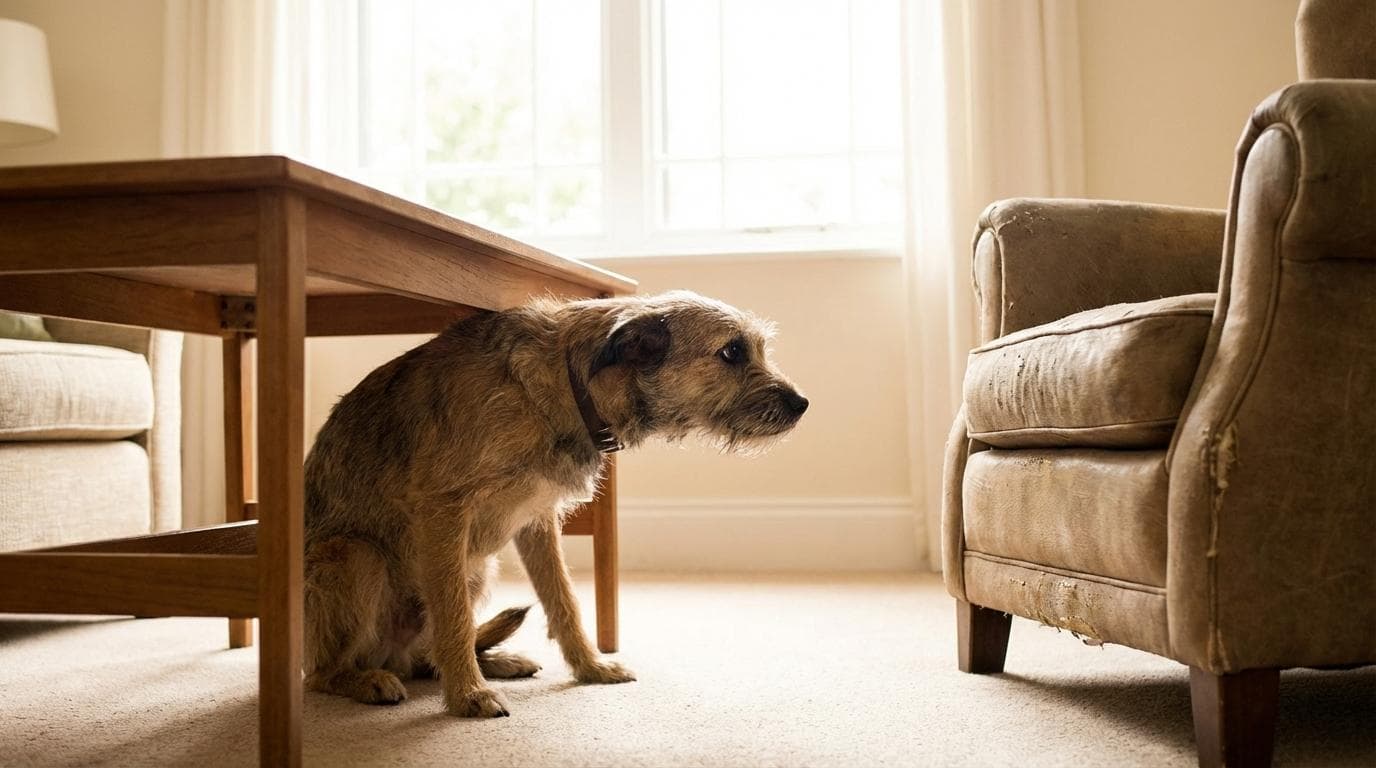
You reach down to pet your dog and they flinch. You take them for a walk and they freeze at the sight of a plastic bag rustling on the sidewalk. A stranger says hello and your dog tucks their tail, flattens their ears, and tries to make themselves as small as possible. You've had them since puppyhood. You've been nothing but gentle and patient. And still, the world seems to terrify them.
If this sounds familiar, you're living with what behavioral science calls a high-fear dog — and specifically, you may be dealing with the Fearful Reactor archetype. Understanding why your dog responds to the world this way isn't just interesting. It's the essential first step toward helping them lead a calmer, more comfortable life.
What Is the Fearful Reactor Dog Archetype?
The Fearful Reactor is a dog whose default response to novelty, uncertainty, or perceived threat is withdrawal and avoidance rather than investigation or engagement. Unlike reactive dogs who respond to triggers by charging forward — barking, lunging, pulling toward the source — the Fearful Reactor typically responds by retreating, freezing, or shutting down entirely.
This might look like:
- Pressing against a wall or behind your legs in new environments
- Refusing to move on walks when something unfamiliar appears ahead
- Rolling over or urinating submissively when approached by strangers
- Trembling, yawning excessively, or panting without physical cause
- Refusing food in contexts that feel threatening — a significant signal in a dog that normally eats eagerly
The Neuroscience Behind Fearful Dog Behavior
Fear in dogs — as in all mammals — is regulated primarily by the amygdala, a small structure in the brain that functions as the threat-detection center. When the amygdala identifies a potential danger, it triggers the stress cascade: cortisol and adrenaline flood the system, heart rate increases, digestion slows, and the body prepares to fight, flee, or freeze.
In most dogs, this system is appropriately calibrated. It activates in response to genuine threats and quiets once the threat has passed. In high-fear dogs, the threshold is dramatically lower. Stimuli that other dogs process without concern — a raised voice, an unfamiliar person entering the room, an unexpected noise outside — trip the amygdala into full threat-response mode.
This is not a choice your dog is making. Your Fearful Reactor is not deciding to be afraid. Their nervous system is literally wired to perceive threat more readily than other dogs. That wiring comes from a combination of genetics, early experience, and individual neurological variation — and it cannot be corrected by patience alone, though patience is essential.
Why Some Dogs Are Wired for Fear
Genetics and Fearful Dog Behavior
Fear sensitivity has a clear heritable component. Research on dog populations has consistently shown that fearfulness and anxiety cluster within breed lines and within family lines. Certain breeds — particularly some herding breeds, some hounds, and many rescue dogs of unknown lineage — show elevated baseline fearfulness compared to others.
But breed is not destiny. Individual variation within any breed is enormous, and some dogs in typically confident breeds are profoundly fearful while some dogs in typically anxious breeds are remarkably calm. What genetics does is set the baseline threshold. A dog with a genetic predisposition toward fearfulness will have a lower stress threshold and a stronger default stress response — which means they need more careful, consistent support, not different care.
The Role of the Socialization Window
The socialization window in dogs runs roughly from 3 to 16 weeks of age. During this period, the brain is primed to encode what is normal and safe in the world. Positive, varied experiences during this window build a broad comfort zone. Absence of experience — a puppy kept isolated, raised in a sterile environment, or deprived of normal social contact — produces a narrow one.
The Fearful Reactor often comes from one of two backgrounds: they either had a traumatic early experience that conditioned a strong fear response, or they had an impoverished early experience that failed to build the baseline sense of safety that confident adult dogs rely on. Both paths produce a dog who enters the world without the neural scaffolding needed to find novelty manageable.
Chronic Stress History
A dog who has spent extended time in a high-stress environment — a puppy mill, a neglectful household, an overwhelming shelter — develops a chronically elevated stress baseline. Their system runs hot. When stress hormones never fully metabolize between exposures, the threshold for a new stress response gets progressively lower.
By the time these dogs arrive in a safe, loving home, they may respond to completely benign stimuli with the full intensity of a genuine threat response — not because they're irrational, but because their nervous system has been shaped by an environment where threat was constant. The body remembers even when the circumstances have changed.
What Living With a Fearful Reactor Looks Like
Fearful Reactors are often exhausting to live with — not because they're difficult in the ways people expect from problem dogs, but because their fear affects everything. Walks become careful negotiations. Visitors require advance planning. Vet visits are genuinely traumatic. New environments demand significant preparation. And the dog's quality of life — their ability to experience joy, curiosity, and ease — is diminished by the constant presence of fear.
Many owners of Fearful Reactors feel guilty, confused, or quietly defeated. They've done everything right. The dog is safe, loved, well-fed, and gently handled. And still, the dog trembles when an unfamiliar person comes close. Understanding that this is biology — not a reflection of the quality of care or the dog's capacity for happiness — is important. Both for the dog and for the person who loves them.
How to Help a Dog Who Is Afraid of Everything
Never Force Contact
The worst thing you can do with a Fearful Reactor is force them into contact before they're ready. Pushing a fearful dog toward the thing that frightens them — allowing a stranger to reach down and pet them before the dog has chosen to approach, carrying them into a crowd, holding them still while they try to escape — doesn't teach them the experience is safe. It teaches them they cannot escape it. That deepens the fear and erodes the trust between you.
The foundational rule with Fearful Reactors is to let them choose. Let them approach when they're ready. Let them retreat when they need to. Build a reliable sense of safety before you build any exposure plan.
Use Counter-Conditioning to Change Fearful Dog Associations
Counter-conditioning is the most evidence-based tool available for fearful dogs. The principle is straightforward: pair the scary thing with something the dog genuinely loves, repeatedly, until the scary thing begins to predict the good thing rather than the threat.
In practice: when a stranger appears on a walk, start delivering high-value treats the moment your dog notices the stranger — before any fear response begins. Stranger appears, treats appear. Stranger moves away, treats stop. Across many repetitions in many contexts, the dog's emotional response begins to shift from anticipatory dread to something closer to cautious anticipation.
For counter-conditioning to work, exposure must happen below threshold. This means at a distance or intensity where the dog can notice the trigger without fully reacting. If your dog is already trembling, refusing food, or trying to flee, they're above threshold and learning is not happening. Increase the distance and begin again.
Predictability Is Therapeutic for Fearful Dogs
Fearful dogs find unpredictability genuinely distressing. A reliable daily routine — consistent mealtimes, consistent walk routes in the early stages of work, consistent handling — lowers the ambient anxiety that amplifies fear responses. When a dog knows what to expect, they spend less cognitive and emotional energy bracing for the unknown.
This doesn't mean you can never introduce anything new. It means you introduce novelty intentionally and carefully, with enough predictable safety surrounding it that the dog can manage the experience without exceeding their threshold.
Know When to Seek Professional Help
For dogs with significant fear — particularly dogs whose anxiety prevents them from functioning normally in daily life, or dogs with any history of fear-based snapping or biting — a veterinary behaviorist can assess whether anti-anxiety medication is appropriate. Not as a permanent solution, but as a tool to bring the dog's baseline down enough that behavior modification can actually take hold.
Medication does not remove fear. What it does is reduce the intensity of the fear response and lower the threshold at which a dog can begin to engage with counter-conditioning. For dogs whose stress response is so immediate and overwhelming that they cannot process new information in any high-fear context, medication can make the difference between slow, steady progress and no progress at all.
Take our free 2-minute Dog Archetype Quiz to discover whether your dog matches the Fearful Reactor profile — and get guidance tailored specifically to their behavioral needs.