Everyone told you that socialization happens before 16 weeks. The window closes, the personality is set, and if you missed it — well, you missed it. Your dog will just be "that dog" who can't handle other dogs, panics in new environments, and barks at every unfamiliar person.
That's not true. But it's not entirely false either, and understanding the distinction is crucial to helping your adult dog become more comfortable with the world.
The puppy socialization window is real — experiences between 3-16 weeks carry disproportionate weight in shaping a dog's adult temperament. But the brain doesn't stop learning at 16 weeks. Adult dogs can absolutely become more confident, more tolerant, and more socially skilled. The process is just slower, more deliberate, and follows different rules than puppy socialization.
Why Adult Socialization Is Different
During the puppy socialization window, the brain is optimized for absorbing new experiences. Novel stimuli are processed with curiosity rather than suspicion. A puppy who meets a man in a hat at 10 weeks thinks "interesting new thing." An under-socialized adult dog who encounters a man in a hat for the first time at 3 years thinks "potential threat."
This isn't a character flaw — it's a survival mechanism. Adult brains are supposed to be more cautious. The animal who approaches everything with puppy-like openness in adulthood is the one who gets eaten. Your adult dog's wariness isn't dysfunction — it's their brain doing exactly what evolution designed it to do.
This means adult socialization isn't about flooding your dog with novel experiences. It's about carefully, gradually expanding their comfort zone while respecting their legitimate caution.
Step 1: Assess Where Your Dog Actually Is
Before you can socialize effectively, you need an honest assessment of your dog's current social comfort level. Not where you want them to be, but where they actually are right now.
- What triggers anxiety? All strangers, or just certain types (men, children, people in uniforms)? All dogs, or just specific sizes, breeds, or play styles?
- At what distance? Does your dog react when a trigger is 50 feet away or only at 10 feet? The distance at which your dog notices the trigger but remains calm is your starting point.
- What does the anxiety look like? Mild avoidance? Hard stares? Barking and lunging? The intensity tells you how deeply the fear is rooted.
- What contexts are comfortable? Most under-socialized dogs have some situations where they're fine. Identifying these comfortable contexts gives you a baseline and reveals what your dog can handle.
Step 2: Counter-Conditioning, Not Exposure
The biggest mistake owners make with adult socialization is treating it like puppy socialization — just take the dog everywhere and let them "get used to it." With adult dogs, forced exposure to feared stimuli doesn't create habituation. It creates sensitization. Each negative experience makes the next one worse.
Counter-conditioning is the approach that works for adult dogs. The principle is simple: pair the presence of the scary thing with something the dog loves, at a distance where the dog is aware of the trigger but not reacting to it.
- Scary thing appears at safe distance → high-value treats flow
- Scary thing disappears → treats stop
- Repeat until the dog actively looks for treats when they see the trigger
- Gradually decrease distance over days or weeks
Step 3: Controlled Introductions, Not Dog Parks
Dog parks are terrible socialization environments for under-socialized adult dogs. They're chaotic, unpredictable, and full of dogs with varying social skills. Sending an under-socialized dog into a dog park is like sending someone with social anxiety to a mosh pit as therapy.
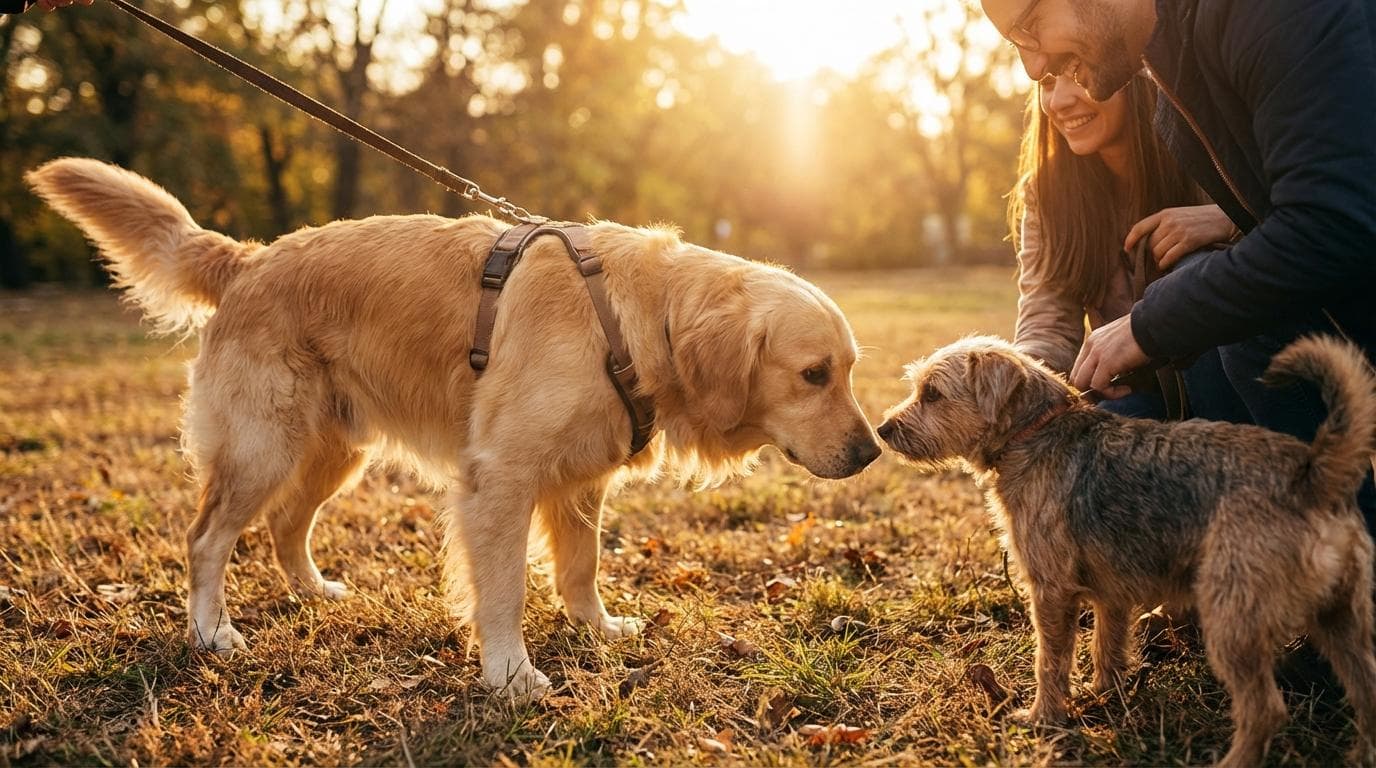
Instead, arrange controlled introductions with known, calm, socially skilled dogs. The ideal introduction partner is an adult dog who is confident but not pushy, interested but not overwhelming, and capable of reading and respecting your dog's body language.
Start with parallel walks — both dogs walking in the same direction with plenty of space between them. No direct interaction, just calm coexistence. Over multiple sessions, gradually decrease the distance. Eventually, allow brief, leashed greeting opportunities. Only progress to off-leash interaction in a secure area when both dogs have demonstrated consistent comfort at every previous stage.
Step 4: Build Confidence Through Competence
Socialization isn't just about direct exposure to triggers. It's about building your dog's overall confidence so they have more emotional resilience to draw on when they encounter something unfamiliar.
Confidence-building activities include:
- Trick training: Learning new skills and being rewarded for them builds a dog's belief in their own ability to navigate the world successfully
- Scent work: Nose work builds confidence because dogs are naturally skilled at it — it's the rare activity where dogs don't fail
- Parkour/environmental exploration: Teaching your dog to climb on, walk over, and navigate novel surfaces and objects builds general confidence that transfers to social situations
- Agility foundations: Navigating obstacles with handler support builds both confidence and trust in you
Step 5: Manage Your Expectations
An adult dog who missed early socialization will likely never be the dog who joyfully greets every stranger and plays enthusiastically with every dog at the park. That's okay. The goal isn't to create a social butterfly — it's to create a dog who can navigate the world without chronic stress.
Success looks like:
- Being able to walk past other dogs without reacting
- Tolerating veterinary handling without panic
- Remaining calm when guests enter the home (perhaps from a safe distance)
- Recovering quickly from unexpected encounters rather than shutting down for hours
Common Mistakes to Avoid
- Moving too fast: If your dog shows stress at any stage, you've moved too quickly. Go back to the distance or context where they were comfortable and progress more slowly
- Forcing greetings: "He needs to learn" is not a valid reason to push your dog past their comfort zone. They need to learn at their own pace, not yours
- Punishing fear reactions: Barking, growling, and lunging are communication. Punishing these behaviors doesn't reduce fear — it suppresses warning signals, making the dog more likely to bite without warning
- Inconsistency: Sporadic socialization attempts are less effective than consistent, brief, positive exposures. Five minutes of counter-conditioning three times a week beats one overwhelming 30-minute session