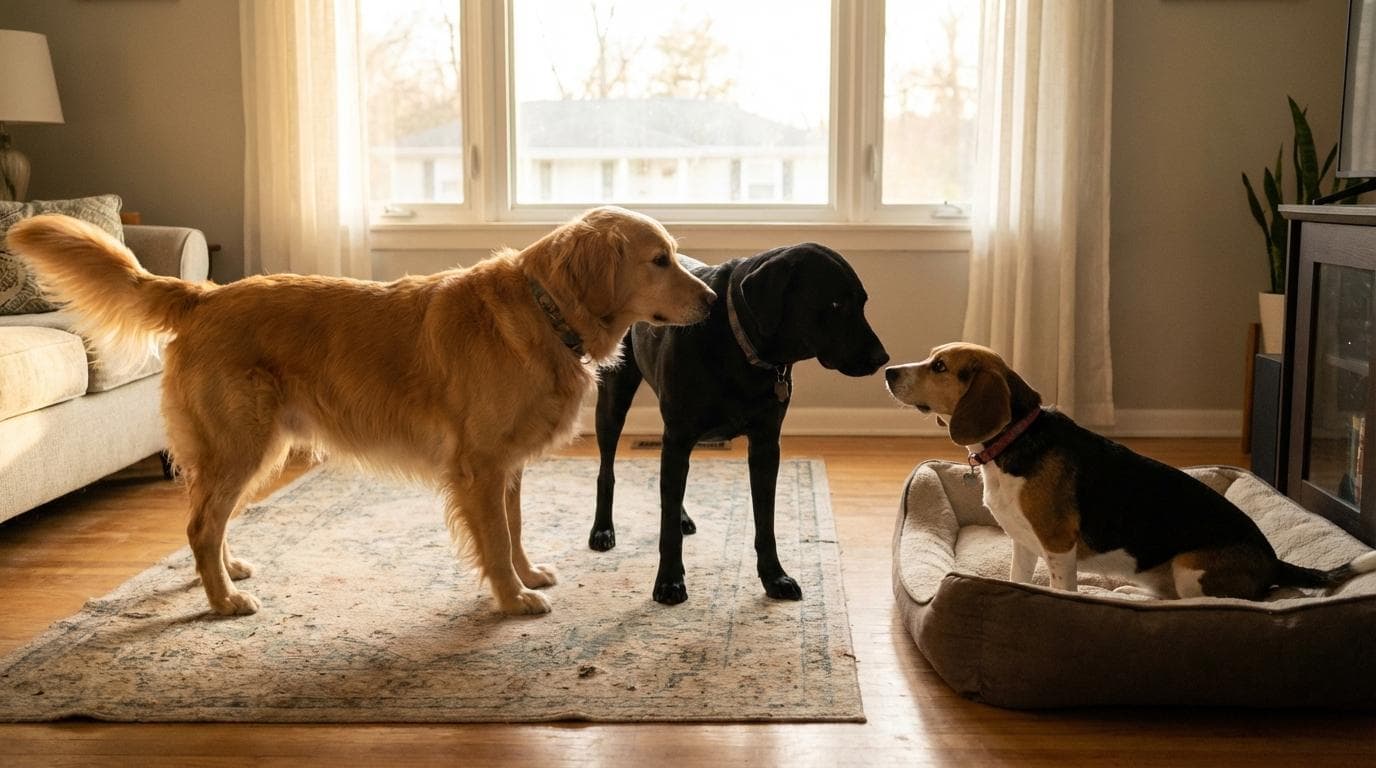
You got a second dog because you thought your first dog needed a friend. Maybe you were right. Or maybe you've just introduced a roommate your first dog didn't ask for into their home, and now you're dealing with growling over food bowls, tension in doorways, fights that seem to come from nowhere, and the sinking realization that your two dogs might never be the best friends you imagined.
Multi-dog conflict is one of the most stressful situations dog owners face because it happens in your own home — the one place that's supposed to be safe and calm. Understanding why dogs in the same household fight, and what's actually driving the tension, is essential to restoring peace.
Why Dogs in the Same Household Conflict
Dogs who live together don't automatically like each other. Proximity does not equal friendship. In the wild, canids choose their social groups and can leave when relationships become strained. In a household, dogs are forced together by human decisions, and they don't always agree on the arrangement.
Resource Competition
The most common source of multi-dog conflict is competition over valued resources: food, toys, chews, resting spots, attention from humans, and access to doorways or preferred locations. Even in homes where resources seem abundant, dogs may perceive scarcity. One dog controls the water bowl. Another claims the couch. A third gets first access to the door.
These micro-conflicts often simmer below the surface as low-level tension — hard stares, body blocking, lip curls — that owners don't notice until it escalates into a fight. Dogs with strong Territorial Protector traits are especially likely to resource-guard in multi-dog homes, extending their guarding instinct from objects to spaces and even people.
Incompatible Energy Levels
A high-energy 2-year-old dog paired with a low-energy 8-year-old dog is a recipe for conflict. The younger dog wants constant play. The older dog wants to be left alone. The young dog's persistent attempts to engage are tolerated, then warned off with a growl, and eventually met with a snap or fight.
Energy incompatibility also matters in same-age pairs. Two dogs who are both highly aroused and competitive can escalate play into fights because neither has the impulse control to de-escalate. Two dogs who are both anxious can feed each other's anxiety, creating a household where stress compounds rather than balances.
Unclear Social Structure
Dogs do establish social hierarchies within groups, but the hierarchy isn't the rigid "alpha" system that popular culture suggests. It's fluid, context-dependent, and negotiated through subtle social signals. Dog A might defer to Dog B around food but have priority access to the couch. Dog B might be confident outdoors but submissive indoors.
Problems arise when humans interfere with the natural negotiation process — forcing a "weaker" dog to eat first, punishing the "dominant" dog for asserting priority, or treating both dogs identically when their social relationship is naturally asymmetric. These interventions prevent the dogs from establishing a stable, mutually understood arrangement.
Warning Signs That Tension Is Building
Most fights don't come from nowhere. There are almost always warning signs that owners can learn to read:
- Hard stares between dogs: Prolonged, unblinking eye contact is confrontational, not friendly
- Body blocking: One dog physically positioning themselves between the other dog and a resource, person, or doorway
- Freezing: Either dog becoming very still, especially over food or a coveted item
- Lip lifts and air snaps: Warning signals that are often punished when they should be heeded
- One dog consistently avoiding the other: The avoiding dog has learned that proximity leads to conflict
- Over-the-top play that never resolves: Play that escalates in intensity without breaks or role reversals
Management Strategies That Work
Separate Feeding
Feed dogs in separate rooms with closed doors. This is non-negotiable in any multi-dog household with tension. Each dog should be able to eat at their own pace without monitoring the other dog's bowl or worrying about competition. Keep the doors closed until both dogs have finished eating.
Provide Abundant Resources
The formula is simple: one of everything per dog, plus one extra. Two dogs need three water bowls, three resting spots, and three toy options. This doesn't eliminate guarding — a dog who guards will guard regardless — but it reduces the pressure that triggers guarding behavior.
Supervised Togetherness
If your dogs have a history of fighting, they should not be left unsupervised together. This isn't a permanent sentence — it's management while you work on the relationship. Use baby gates, separate rooms, or crate-and-rotate systems to ensure that both dogs are safe when you can't actively monitor their interactions.
Individual Time
Each dog needs individual time with you — separate walks, separate training sessions, separate attention. This reduces competition for your attention and allows each dog to relax without monitoring the other dog's proximity to you.
Exercise Before Togetherness
Dogs who are physically and mentally tired are less likely to conflict. Walk each dog separately (or together if they walk well together), then bring them into shared space when their arousal levels are lower.
Introducing a New Dog to a Resident Dog
If you haven't gotten the second dog yet, or if the introduction went badly and you need to restart, here's a framework:
- Meet on neutral ground first. A park, a neighbor's yard — anywhere that isn't the resident dog's territory. Walk the dogs in parallel, gradually decreasing distance.
- Enter the home separately. Let the new dog explore the house while the resident dog is elsewhere. Then swap — let the resident dog sniff the spaces the new dog explored. This lets each dog gather information without confrontation.
- Supervise all early interactions. Short, structured interactions with plenty of breaks. End on a positive note. Gradually increase the duration as the dogs demonstrate comfort.
- Expect a settling-in period. Even compatible dogs typically need 2-4 weeks to establish their relationship. Occasional tension during this period is normal. Sustained aggression is not.
When to Seek Professional Help
Some multi-dog conflicts are beyond management alone. Consult a certified veterinary behaviorist or a professional who specializes in multi-dog dynamics if:
- Fights have resulted in injury (puncture wounds, not just noise)
- One dog is consistently terrorized and unable to relax
- Fights are increasing in frequency or intensity
- You feel unsafe separating the dogs during conflicts
Every dog in your household has a unique behavioral archetype that influences how they relate to other dogs. Take the free Dog Archetype Quiz for each of your dogs to understand their individual patterns and learn how those patterns interact in your specific household.