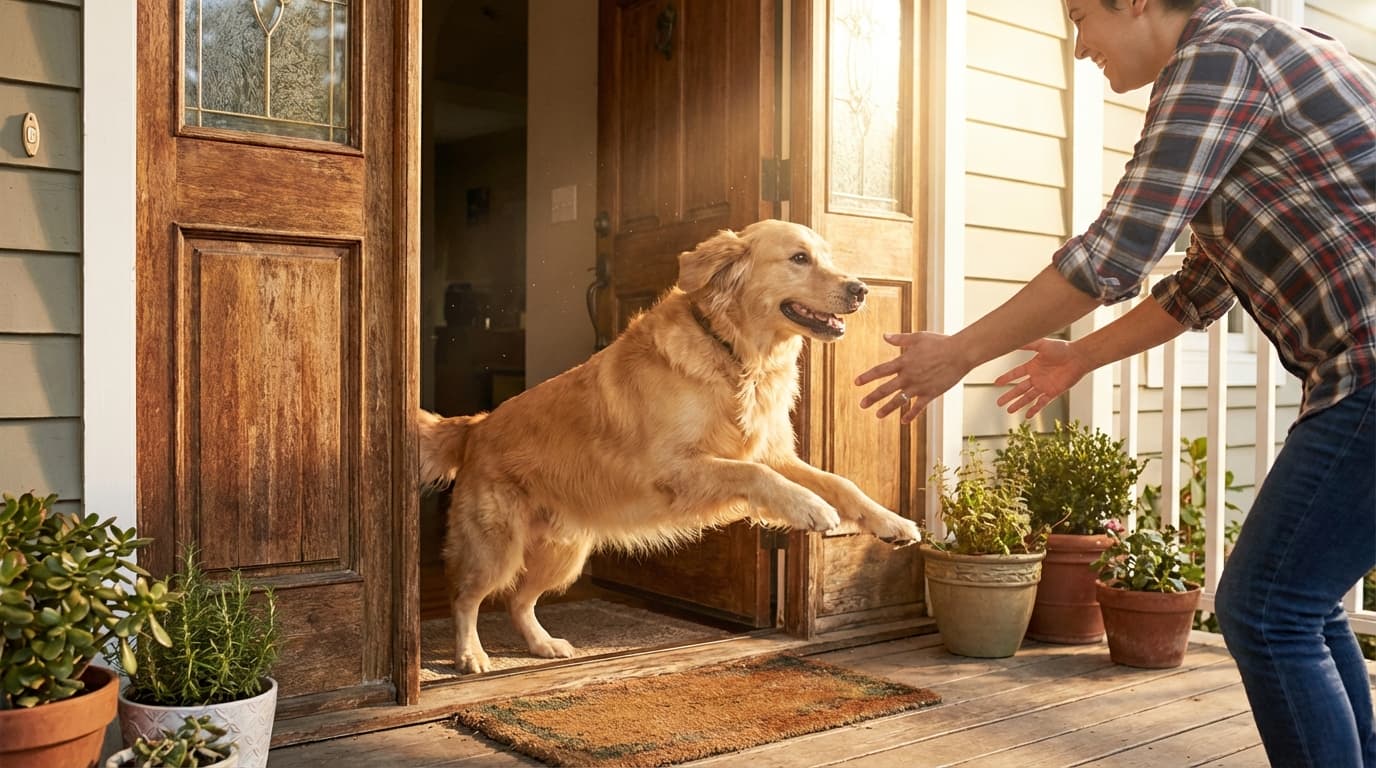
Every dog owner knows the scene. You open the front door, a guest steps inside, and your dog launches into a full-body celebration that involves paws on chests, frantic licking, and a tail wagging so hard it could power a small fan. While your dog means well, over-excited dog greetings can knock guests off balance, scare children, and turn every visit into a wrestling match. Understanding why your dog jumps on people is the first step toward calmer, safer hellos.
Jumping is not a sign of disobedience. It is a deeply social behavior rooted in how puppies greet adult dogs, by licking their muzzles. When a puppy grows into a sixty-pound adult and still tries to reach your face, the behavior becomes a problem for humans but remains perfectly logical from your dog's perspective. According to the American Kennel Club, jumping is one of the most common complaints among dog owners, yet it is also one of the most misunderstood behaviors. Most dogs that jump are simply doing what feels natural, and they have never been taught a better way to say hello.
Why Dogs Jump During Greetings
Dogs jump because proximity to faces is hardwired into canine social behavior. Puppies lick the mouths of returning adults to solicit food and attention, and this instinct does not fade with age. When your dog leaps at a visitor, the motivation is almost always excitement and affection, not dominance or defiance. The rush of adrenaline that comes with a new arrival can override any training your dog has received in calmer moments.
Some dogs are more prone to over-excited greetings than others. High-energy breeds like Labrador Retrievers, Golden Retrievers, and Boxers tend to express enthusiasm with their entire bodies. Dogs that fit the overstimulated-hunter profile are especially susceptible because they struggle to regulate arousal once it begins. Their nervous systems shift into overdrive at the first sound of a doorbell, and returning to baseline takes longer than it does for mellower dogs. If your dog seems unable to calm down for several minutes after a guest arrives, arousal regulation rather than simple obedience is likely the core issue.
Environmental factors also play a role in how intense greetings become. Dogs that spend long hours alone are more likely to explode with excitement when someone finally walks through the door. Dogs that rarely encounter new people may find each visitor overwhelmingly stimulating simply because the experience is novel. Understanding the specific triggers behind your dog's jumping helps you design a training plan that addresses the root cause rather than just the surface behavior.
The Problem with Punishing Excited Greetings
Many owners instinctively push their dog down, yell "off," or knee the dog in the chest. These reactions rarely work for a simple reason: any attention, even negative attention, can reinforce jumping. A dog in a state of high arousal is not thinking clearly enough to connect a punishment with the specific behavior. Instead, the dog learns that greetings are stressful and unpredictable, which can lead to anxiety-driven behaviors like barking, nipping, or avoidance.
The ASPCA warns against physical corrections for jumping because they risk damaging the trust between dog and owner. A dog that associates visitors with being kneed or shouted at may begin to show fearful or aggressive responses at the door. Repeated punishment can also erode your dog's confidence in social situations, making the dog hesitant around new people rather than genuinely calm. The goal should be teaching your dog what to do instead of jumping, not simply punishing the jump itself. Positive reinforcement gives your dog a clear alternative that earns rewards, making it far more effective than correction-based approaches.
Teaching a Reliable Alternative Behavior
The most effective replacement for jumping is a solid "sit" or "four on the floor" protocol. The concept is straightforward: your dog only receives attention when all four paws are on the ground. The moment the paws leave the floor, all interaction stops. This requires consistency from every person who enters your home, which is often the hardest part of the entire process.
Start by practicing in low-distraction environments. Ask your dog to sit before meals, before leash clips, and before you open the back door. Once the sit is automatic in calm settings, begin adding mild excitement. Have a family member walk out and re-enter the room. If your dog holds the sit, reward immediately with a treat and calm praise. If the dog jumps, the person turns around and walks back out without a word. Repeat until the dog understands that sitting earns attention and jumping makes people disappear.
Gradually increase the difficulty by recruiting friends to help. Ask them to ring the doorbell and wait. Open the door only when your dog is sitting. If your dog breaks the sit, close the door and wait. This process takes patience, sometimes weeks of daily practice, but it builds a habit that replaces jumping without conflict. Keep treats near the door so you can reward your dog the instant four paws are on the ground. Timing matters enormously here. A reward delivered within one second of the correct behavior is far more effective than praise that comes five seconds later.
Managing Excitement Before Guests Arrive
Prevention is just as important as training. If you know guests are coming, burn off some of your dog's excess energy beforehand. A brisk twenty-minute walk, a game of fetch, or a puzzle feeder can lower your dog's baseline arousal so the doorbell does not trigger a full explosion. Dogs that are mentally and physically tired are far less likely to launch themselves at visitors.
Consider using a leash inside the house during greetings. Tethering your dog to a sturdy piece of furniture or holding the leash gives you physical control without confrontation. Once the initial excitement passes and your dog offers calm behavior, release the leash and allow interaction. This management tool is not a permanent solution, but it prevents rehearsal of the jumping behavior while your training plan takes hold.
Another useful technique is the "place" command, where your dog goes to a specific mat or bed when the doorbell rings. Teaching "place" gives your dog a job to do instead of rushing the door. Start by rewarding your dog for going to the mat on cue, then gradually add the doorbell as a trigger. Over time, the sound of the bell becomes a signal to go to the mat rather than a signal to charge. You can combine this with a long-lasting chew or stuffed food toy on the mat, giving your dog something productive to do while you welcome your guest.
When Over-Excited Greetings Signal a Bigger Issue
Occasional jumping in a young dog is normal, but dogs that cannot settle within five to ten minutes after a guest arrives may be dealing with arousal dysregulation. This is common in dogs that match the overstimulated-hunter archetype, dogs whose nervous systems run hot and who struggle to shift from high gear to neutral. For these dogs, greeting training alone may not be enough. You may need to work on overall impulse control through exercises like "wait" at doorways, "leave it" games, and structured settle protocols where your dog practices lying calmly on a mat for increasing durations.
If your dog's greeting behavior includes mouthing, body slamming, or vocalizing that escalates rather than fades, consult a certified professional dog trainer or veterinary behaviorist. These patterns can sometimes indicate underlying anxiety or compulsive tendencies that benefit from a tailored behavior modification plan. The American Kennel Club maintains a directory of AKC Canine Good Citizen evaluators who can assess your dog's social skills and recommend next steps.
Understanding your dog's unique behavioral profile makes training more effective. Every dog processes excitement differently, and what works for a laid-back hound may not work for a high-drive terrier. Take the free quiz to discover your dog's archetype and get personalized strategies for managing excitement, building impulse control, and strengthening the bond between you and your dog.
Further Reading
- How to Stop Your Dog from Jumping on People - American Kennel Club
- Dog Behavior: Jumping - ASPCA