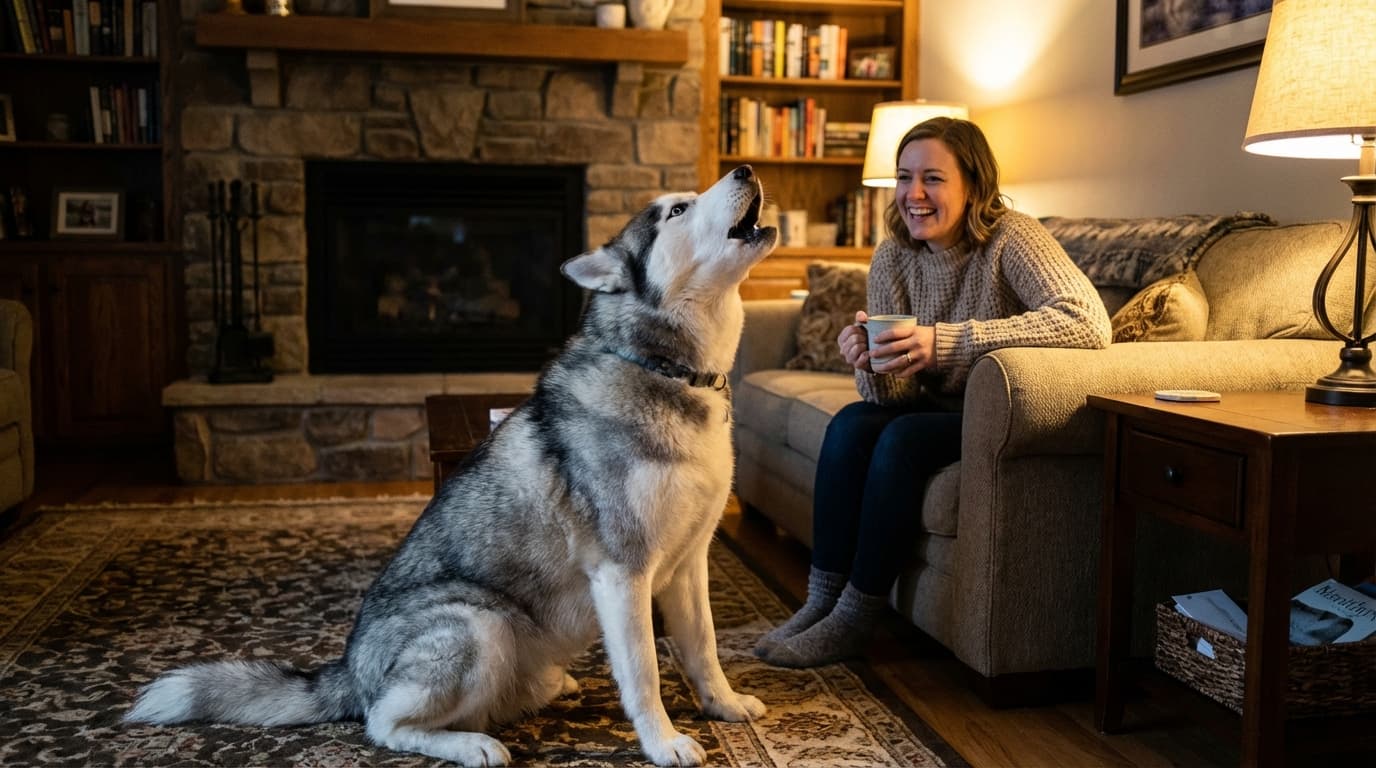
You told your Husky they couldn't have your sandwich. Now they're lying on the kitchen floor, eyes averted, making a sound that falls somewhere between a moan, a howl, and a deeply personal grievance. Your neighbor probably thinks something terrible is happening. Nothing is happening. Your Husky is just being a Husky.
If you live with one, you know the drill. Huskies are the drama queens of the dog world — and not in a cute, harmless way that you can easily ignore. Their vocalizations are operatic. Their protests are theatrical. Their energy levels are extreme. And if you don't understand the biology and breed history driving all of this, managing it feels impossible.
Here's the thing: your Husky isn't trying to manipulate you or push your buttons. They're behaving exactly the way thousands of years of selective breeding shaped them to behave. Understanding that is the first step toward a calmer household.
Husky Howling and Vocalization: A Biological History
Siberian Huskies were developed by the Chukchi people of northeastern Siberia over several thousand years. The job description was extraordinarily specific: pull sleds across vast, frozen distances in teams of dogs, with minimal human supervision, in some of the harshest conditions on earth.
That job required dogs who could communicate with each other and with their humans at a distance. It required dogs who didn't shut down or stop working when things got hard. It required dogs who were, in a word, persistent. Huskies who quietly gave up and waited for direction were not useful. Huskies who howled, pushed, communicated, and kept going were exactly what was needed.
Every dramatic vocalization your Husky produces today is an echo of that selective pressure. The howling that carries across your apartment building? It was designed to carry across kilometers of Arctic tundra. The woo-woo sounds they make when you come home? That's a communication system that evolved to work over distances where barking wouldn't be audible. Your Husky isn't being difficult. They're being a perfectly constructed version of what they were bred to be.
Why Husky Tantrums Happen
The Husky tantrum — that full-body protest involving howling, rolling, dramatic floor-flops, and expressive side-eye — is one of the more entertaining and exhausting features of the breed. Understanding what triggers it helps enormously.
Huskies are what we categorize as the Overstimulated Athlete archetype: dogs with extremely high working drives, high environmental sensitivity, and a strong need to expend both physical and mental energy. When that need goes unmet, they don't quietly wait. They communicate their dissatisfaction at full volume and with full commitment.
Common tantrum triggers include:
Insufficient exercise. A Husky who has not had meaningful physical output is a Husky who is going to find outlets for that energy, and those outlets are rarely the ones you'd choose. The breed was built to run 100 miles a day in harness. Your forty-minute walk is not meeting that requirement.
Boredom and mental understimulation. Physical exercise alone is not enough for Huskies. Working sled dogs had cognitive demands built into their job — navigating terrain, responding to commands, working as a team. Without structured mental engagement, a Husky's overactive brain turns to problem-solving, and the problems they choose to solve are your furniture, your garden, and your sleep schedule.
Frustration at unmet expectations. Huskies form strong expectations about their routines. If you're late for the walk, if you've changed the schedule, if they want something and aren't getting it, the vocalization is not manipulation — it's genuine distress communication. They don't have a volume knob, and they weren't designed to stay quiet about discomfort.
Temperature. Huskies have a double coat engineered for sub-zero conditions. A warm apartment in summer is genuinely uncomfortable for them, and their behavior often reflects that physical stress.
Husky Training: What Works and What Doesn't
The most common mistake people make with Huskies is assuming that what works with other breeds will work with them. Standard obedience approaches often fail because they're designed for dogs who are more naturally oriented toward human direction. Huskies are independent thinkers. They ran in teams with minimal handler contact — they were not designed to take cues from a human every few seconds.
This doesn't mean they can't be trained. It means the approach has to account for their specific cognitive style.
Reward-based training works significantly better with Huskies than correction-based methods. A Husky who is corrected for vocalizing will often simply vocalize more, or shift the behavior sideways rather than suppressing it. They're not being defiant — corrections don't address the underlying driver, so the pressure finds another outlet. Positive reinforcement gives the Husky a clear picture of what earns good things, which is a frame they can work with.
Keep training sessions short and varied. Huskies bore quickly with repetition. Once they've demonstrated that they understand a behavior, asking for it over and over produces either refusal or theatrical protest. Rotate through behaviors, introduce new challenges, and end sessions before they check out.
Recall in Huskies is notoriously difficult to establish off-leash. This is not a failure of your training or your dog's intelligence — it's a breed characteristic. Huskies off-leash will follow their nose and their drive in the direction that interests them, not necessarily back to you. A solid recall in a low-distraction environment should never be assumed to transfer to a high-distraction environment like a park or open field. Manage accordingly.
Accept and manage the vocalization rather than trying to eliminate it. Some Huskies will stop excessive howling when their needs are consistently met and they're well exercised. Most will remain vocal throughout their lives. Working with neighbors, providing white noise, and building routines that minimize trigger events is often more practical than attempting silence.
Meeting the Overstimulated Athlete's Real Needs
A Husky who is genuinely tired — mentally and physically — is a dramatically different animal than one who is under-exercised and bored. Getting there requires honest commitment to what this breed actually needs.
For physical exercise, more is genuinely better. Running, bikejoring, skijoring, hiking with a weighted pack, and canicross (running with your dog in harness) are all legitimate outlets for Husky energy. Swimming is excellent in warm weather. If you're a runner or cyclist, a Husky can be a training partner — but you need to be consistent about it, not occasional.
For mental stimulation, puzzle feeders, scent work, and structured training games address the cognitive demands the breed has. Nosework in particular tends to work well because it taps into the problem-solving drive without requiring the repetitive obedience that Huskies resist. Feeding from interactive toys rather than bowls adds daily cognitive work without extra time investment.
For social and environmental needs, Huskies generally do better with another dog in the home than they do as only dogs — they're pack-oriented by history and tend to find a canine companion regulating rather than further stimulating. They need significant human interaction, but they also have an independent streak that means they won't always be velcro dogs. Respecting both sides of that is important.
Is Your Husky's Drama Actually Anxiety?
Most Husky theatrics are normal breed behavior. But it's worth distinguishing between a dog who is communicating in characteristic ways and a dog who is genuinely distressed.
Signs that your Husky's vocalizations may reflect anxiety rather than just personality include: howling that goes on continuously for extended periods when you leave, destruction focused specifically on exit points (doors, windows), physical signs of stress like panting, trembling, or inability to settle, and escalation rather than de-escalation when their needs are met. This pattern suggests separation anxiety, which is a clinical condition requiring a structured behavior modification protocol — often in combination with veterinary behavioral support.
The Overstimulated Athlete archetype covers both the energetic, dramatic Husky who is working at capacity and the one whose constant output is driven partly by anxiety. Knowing which pattern fits your dog changes the intervention.
The Husky Who Won't Stop Screaming at 6 AM
One specific question Husky owners ask constantly: how do I stop my dog from waking me up before dawn with full-volume demands for breakfast, walks, or attention?
The answer is never to give them what they're demanding. Not once. Not on days when you're desperate. The moment you get up and feed them in response to 6 AM howling, you've confirmed that howling works, and they'll use it reliably. Consistency here is non-negotiable.
Instead, ignore the vocalizations completely until you are ready to get up, then get up and start the routine. Over time, if there is no reinforcement for the early demand, it typically reduces. This takes weeks, not days, and will get worse before it gets better as they try harder before giving up on a strategy that no longer works. It requires earplugs, patience, and the absolute conviction that you will not give in.
Blackout curtains to delay morning light can help with dogs who wake with the sunrise. A sufficient exercise session the evening before reduces early-morning energy peaks. Regular schedules reduce anticipatory excitement.
Living Well With a Husky
Huskies are not a beginner breed, and they're not a breed for people who want a dog who primarily takes direction and stays quiet. They are magnificent, entertaining, stubborn, vocal, high-energy animals who require an owner who finds all of that engaging rather than exhausting.
For people who are up for it, they're extraordinary companions. They're deeply affectionate, genuinely funny, and built for exactly the kind of active outdoor life that many people want a dog for in the first place. The drama is part of the deal — and for the right person, it becomes the best part.
Take our free 2-minute Dog Archetype Quiz to find out if your dog matches the Overstimulated Athlete profile — and get tailored guidance on meeting their specific needs.