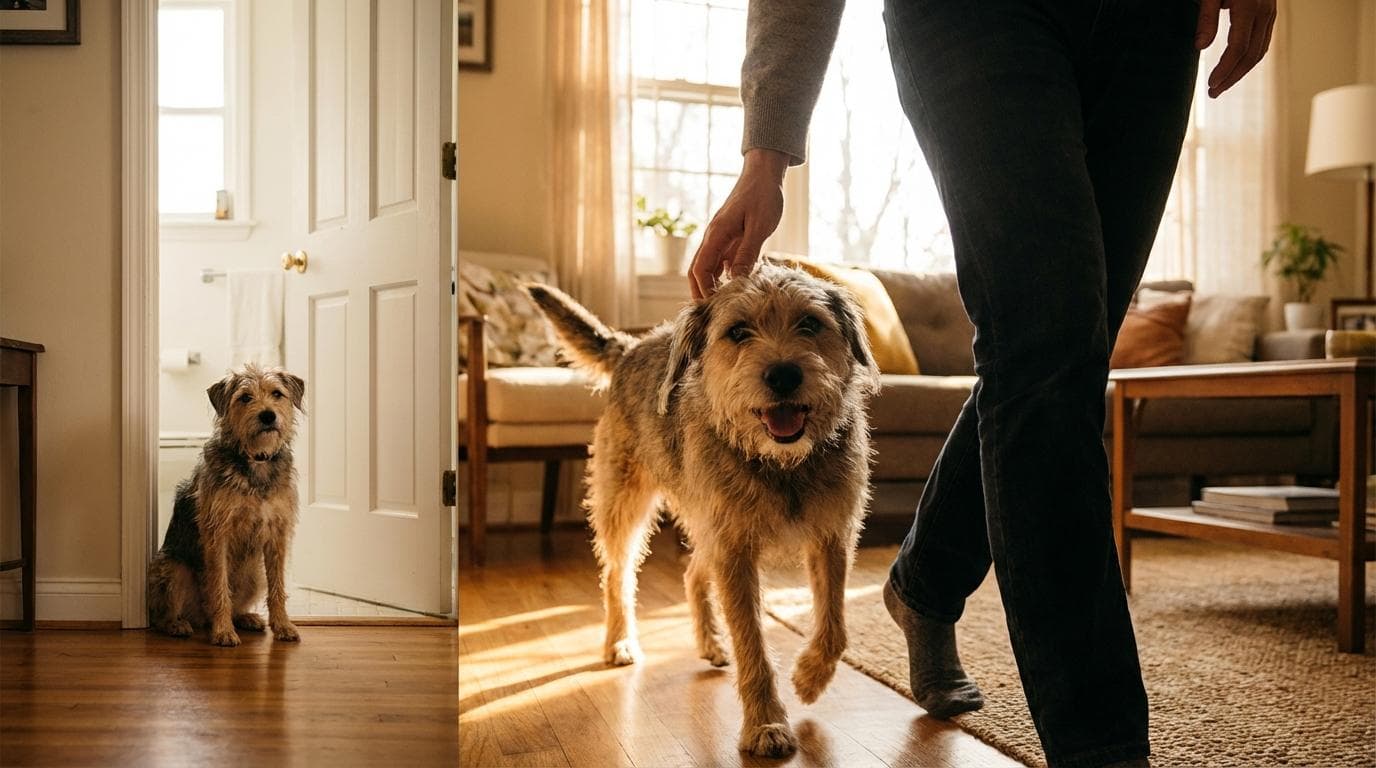
You can't go to the bathroom alone. You can't move from the couch to the kitchen without a furry shadow trailing six inches behind you. You step over your dog to get to the fridge, trip over them on the way back, and find them pressed against the bathroom door when you close it. Your dog follows you everywhere, and while it was cute for the first week, now you're wondering whether something is wrong.
The answer depends entirely on context. Some dogs follow their owners because they're bonded, happy, and naturally social. Other dogs follow their owners because they're anxious, insecure, and unable to cope with even brief separations. The behavior looks identical from the outside. The motivation behind it determines whether it's healthy or problematic.
Normal Following vs. Anxious Following
A dog who follows you because they enjoy your company is relaxed while doing it. Their body language is loose. They follow at a comfortable distance. If you close a door, they might wait outside but they don't panic — they lie down, chew a toy, or find something else to do. When you return, they greet you calmly. They can be left home alone without destructive behavior or distress vocalizations.
A dog who follows you because they're anxious looks different. They follow closely, often underfoot. They become agitated when you move — panting, whining, getting up immediately every time you shift position. If you close a door between you, they scratch, bark, or pace. When you return, even from the next room, the greeting is frantic, as if you'd been gone for hours. And when you actually leave the house, the distress becomes significantly worse.
Dogs who match the Velcro Shadow behavioral archetype exhibit this pattern most strongly. These dogs have organized their emotional regulation around proximity to their person. You aren't just their companion — you're their coping mechanism. Without you physically present, they don't have the internal resources to manage their own anxiety.
Why Dogs Become Velcro Dogs
Breed Tendencies
Some breeds were specifically selected for close human partnership. Cavalier King Charles Spaniels, Vizslas, Italian Greyhounds, French Bulldogs, and many herding breeds were bred to work in close proximity to humans and derive genuine comfort from that closeness. For these breeds, following is partially hardwired.
Reinforcement History
Many owners inadvertently reinforce following behavior from puppyhood. The puppy follows you to the kitchen and gets a piece of chicken. They follow you to the couch and get invited up for cuddles. They follow you to the door and get a walk. Over time, following you becomes the strategy for getting everything good in life. The behavior is heavily rewarded and becomes deeply ingrained.
Lack of Independent Confidence
Dogs who haven't developed independent coping skills rely on their owner's presence as a safety signal. This often happens when puppies are never gradually taught to spend time alone, when rescue dogs bonded intensely to a new owner after a period of instability, or when dogs experienced a traumatic event that shattered their sense of security.
Changes in Routine or Household
Dogs who were previously independent may become clingy after a move, a family member leaving, a new baby arriving, or a change in the owner's schedule. The disruption to their routine creates insecurity, and following becomes a way to monitor the one constant in their changing world — you.
Medical Causes
Sudden-onset clinginess can signal medical issues. Cognitive dysfunction in senior dogs often manifests as increased following and anxiety when the owner is out of sight. Pain, vision loss, hearing loss, and neurological conditions can all make a dog more dependent on proximity to their owner for feelings of safety.
When Following Becomes a Problem
Following is a problem when it:
- Prevents you from accomplishing daily tasks
- Creates tripping hazards (especially for elderly owners)
- Escalates into separation anxiety when you leave
- Indicates the dog has no independent coping skills
- Causes the dog visible stress (panting, whining, pacing when they can't follow)
Building Independence in a Clingy Dog
Teach a "Place" Command
Give your dog a designated spot (a bed or mat) and teach them to go to it and stay. Start with very short durations — 5 seconds — and gradually build up. The goal is to teach your dog that being in a specific location, not glued to your side, is comfortable and rewarding.
Practice Brief Separations at Home
Close a door between you and your dog for 2 seconds. Open it before they react. Gradually increase the duration. Toss a treat to them before you close the door so the separation predicts something good. The goal is to build tolerance for physical separation in micro-doses within the safety of the home.
Reward Independent Behavior
When your dog chooses to lie down across the room from you, quietly reward them. When they chew a toy on their own instead of pressing against your leg, mark it with praise and a treat. You're reinforcing the behavior you want — independent relaxation — rather than only rewarding following.
Provide Enrichment That Doesn't Require You
Stuffed Kongs, puzzle feeders, snuffle mats, and long-lasting chews give your dog something rewarding to focus on that doesn't involve your participation. Start by giving these items while you're present, then gradually begin leaving the room while your dog is engaged. They learn that good things happen even when you're not there.
Avoid Dramatic Departures and Returns
If you make a big deal about leaving — long goodbyes, emotional reassurance, guilty expressions — you're signaling to your dog that departures are a big deal. Similarly, if you return and immediately shower them with excited attention, you're confirming that your absence was worth being stressed about. Keep departures and returns boring and uneventful.
What Not to Do
- Don't punish following. Scolding your dog for being near you doesn't reduce their anxiety — it adds fear to an already anxious state
- Don't suddenly ignore them. Going from constant togetherness to cold turkey separation is overwhelming for an anxious dog. Gradual desensitization is the only approach that works
- Don't lock them away. Confining an anxious dog behind a closed door without preparation creates panic, which deepens the attachment problem rather than resolving it