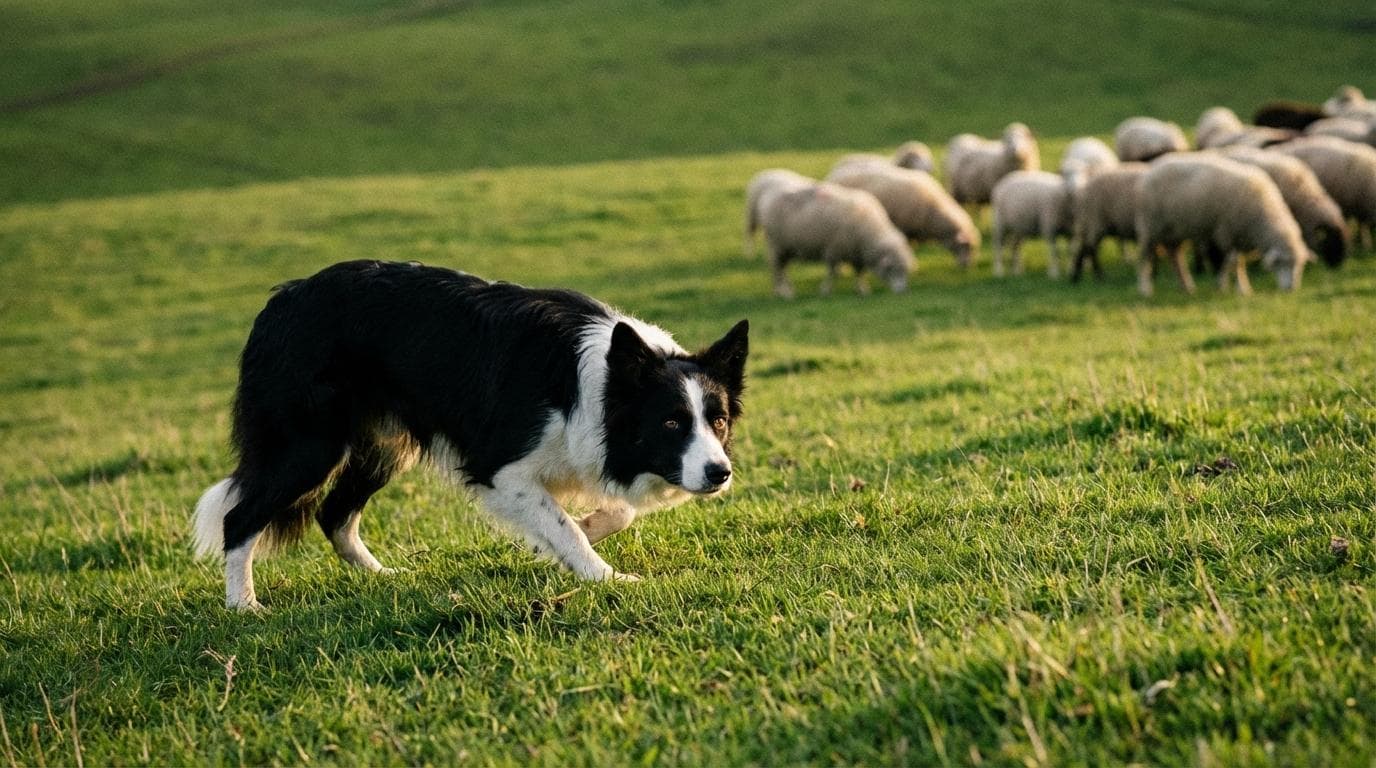
If you share your life with a Border Collie, you already know the intensity. The stare that locks onto a moving bicycle from 200 feet away. The body that coils like a spring the moment another dog rounds the corner. The bark that seems to come from somewhere deep and urgent. Border Collies are extraordinary animals, and their reactivity — when it shows up — is not a random flaw. It is woven directly into what makes them one of the most capable working breeds on earth.
Why Border Collie Reactive Behavior Is a Feature, Not a Bug
Border Collies were developed over centuries to manage sheep across vast, unpredictable terrain. They had to notice everything. A ewe breaking from the flock, a predator at the edge of the field, a gap in the fence line — all of it required split-second awareness and a lightning-fast physical response. The breed was selected, generation after generation, for dogs with a hair-trigger alerting system, exceptional environmental sensitivity, and the drive to act on what they noticed.
That system does not switch off when a Border Collie moves into a suburban home. The genetic machinery is still running. What changes is the context — and that mismatch between the dog's internal wiring and the modern environment is the root cause of most Border Collie reactivity.
A reactive Border Collie is not a broken Border Collie. It is a dog whose finely tuned nervous system is firing in an environment it was never designed for.
The Overstimulated Athlete Archetype
Border Collies are the textbook example of the overstimulated-athlete archetype: a dog with enormous physical and mental capacity who, without adequate structured outlets, redirects that energy into reactive behavior. These dogs are not trying to be difficult. They are attempting to manage an internal state that is genuinely overwhelming.
The overstimulated athlete processes the world at high speed. Stimuli that other dogs filter out — a skateboarder three blocks away, the flicker of a plastic bag in the wind, a child running across a park — register as significant events. Add in a leash that prevents the dog from taking any useful action, and you have a recipe for frustration that expresses itself as barking, lunging, or frantic spinning.
This is important to understand because it changes how you approach the problem. You are not trying to suppress a bad habit. You are trying to help a highly sensitive, high-drive animal learn to regulate an arousal system that is working exactly as it was designed to work.
Common Triggers for Border Collie Reactive Behavior
Understanding what sets your Border Collie off is the first step toward helping them. The most common triggers fall into a few categories.
Fast-Moving Objects
Anything that moves quickly activates the herding instinct. Cars, cyclists, joggers, children on bikes, rolling balls — these are not neutral objects to a Border Collie. They are things to be chased, controlled, or managed. When a leash prevents the dog from doing any of those things, frustration builds rapidly.
Other Dogs on Leash
Off-leash, many Border Collies are perfectly social. On leash, the picture can look completely different. Leash tension increases arousal, removes the ability to approach at a natural pace, and prevents the dog from reading another animal's body language properly. The result is a dog that appears aggressive but is actually frustrated, anxious, or both.
Unfamiliar Environments
Border Collies scan and catalog their environment constantly. A familiar route is manageable. A new street, a busy market, or an unfamiliar park floods the dog's nervous system with unprocessed information. Some individuals respond to this overload with reactive outbursts that would never appear on their home turf.
Insufficient Mental and Physical Stimulation
This is the one owners most often overlook. A Border Collie that has been home all day, or whose only exercise is a loose walk around the block, is running an internal engine with nowhere to put the fuel. That excess energy has to go somewhere, and reactivity is a very efficient pressure valve.
How Border Collie Behavior Changes With the Right Approach
The good news is that the same qualities that make Border Collies reactive — their intelligence, sensitivity, and drive — also make them exceptionally trainable. These dogs respond faster to good training than almost any other breed. The challenge is not capability. It is getting the foundational conditions right.
Start With Threshold Management
Threshold is the distance at which your dog can notice a trigger without going over their emotional limit. Every reactive dog has one, and every training session should begin well outside it. Working inside your dog's threshold — close enough to see the trigger, far enough to remain functional — is where real learning happens.
If your dog is already lunging and barking, you are past threshold. Move away first, then work.
Build a Reliable Interrupt Cue
A solid name response or watch cue is invaluable for herding breed training. Practice it hundreds of times in low-distraction environments before you need it on the street. The goal is to make your dog's name a reflex, not a request. When they hear it, they turn toward you automatically, before arousal can escalate.
Replace Herding Outlets With Appropriate Ones
If your Border Collie has no legitimate channel for their herding drive, reactive behavior becomes the default. Treibball (a sport where dogs herd large exercise balls), agility, competitive obedience, and structured fetch all tap into the same neurological circuitry as herding. They give the dog something to do with the impulse rather than suppressing it.
Even fifteen minutes of focused training — real training, where the dog is problem-solving — does more to reduce reactivity than an hour of unstructured walking.
Address Arousal Before Walks
Many owners head out the door the moment the leash comes out, while their dog is already bouncing off the walls. That baseline arousal level determines how much buffer you have before the dog hits threshold. Teaching a calm settle before the walk begins, asking for a few focus behaviors at the door, and walking at a pace that allows the dog to process their environment — all of these reduce the overall arousal load before you encounter a single trigger.
Herding Breed Training: What Works and What Doesn't
Standard advice for reactive dogs often falls short with Border Collies because it underestimates the breed's cognitive engagement with the problem. Border Collies notice patterns quickly. If your counter-conditioning routine is predictable — trigger appears, treat appears, repeat — many of these dogs will start anticipating the treat the moment they see the trigger, which is actually useful, but they can also start offering operant behaviors to make the treat appear faster.
This is a good sign, not a bad one. It means you can move quickly into teaching explicit alternative behaviors: look at the trigger, look at me, get a treat. Sit when you see a dog. Touch a hand target when a cyclist passes. These dogs want a job, and reactivity management can become a job in itself.
What does not work is flooding — deliberately exposing the dog to the trigger at close range until they stop reacting. For a sensitive, intelligent breed, flooding typically makes reactivity worse and erodes trust in the owner. Patience and systematic desensitization are not slow options. They are the fast ones, because they actually change the underlying emotional state rather than suppressing the visible behavior.
When to Bring in Professional Help
If your Border Collie's reactivity is severe — if they have made contact with another dog or a person, if they are redirecting onto you, or if they are showing signs of distress (panting, shaking, inability to eat) even outside of triggering situations — a certified applied animal behaviorist or a veterinary behaviorist is worth consulting. Some dogs benefit from short-term pharmaceutical support to lower their arousal baseline enough for learning to occur. This is not a failure. It is good science.
Take our free 2-minute Dog Archetype Quiz to discover your dog's behavioral profile and get personalized guidance for your overstimulated athlete.