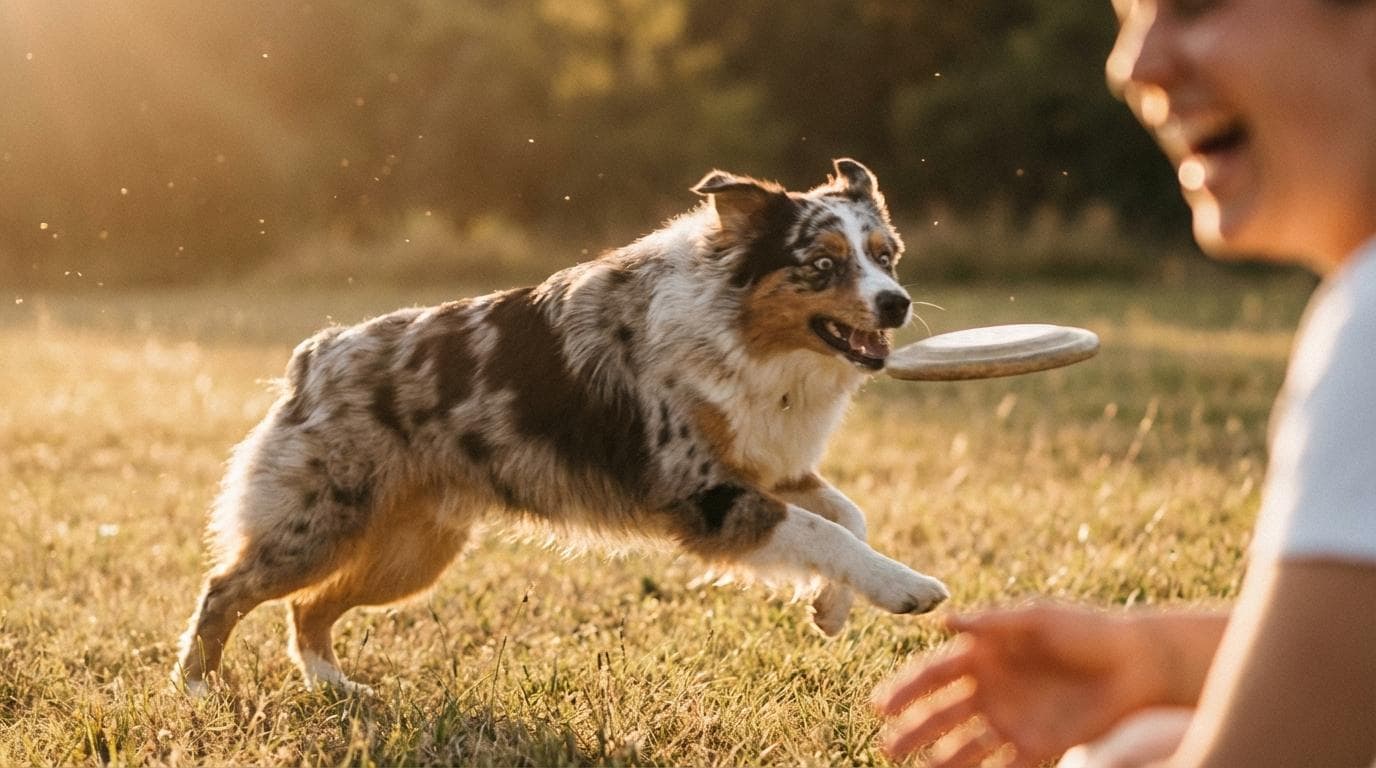
You got the Australian Shepherd puppy and prepared yourself for the high energy. You promised yourself you would exercise them properly. Long hikes on weekends. Daily runs. A backyard. And somehow, after all of it, your Aussie still can't settle. They're spinning, nipping at heels, destroying furniture, nudging your arm every thirty seconds, or barking at literally nothing. You've done everything you were told, and it hasn't worked.
Here's why: you've been solving the wrong problem.
The Australian Shepherd's Brain Is the Real Challenge
Australian Shepherds were bred not just to run, but to make decisions. A working stock dog covering a hillside isn't just exercising their body — they're processing information constantly. Which sheep is moving? Where is the flock going? What angle should I take to redirect that stray? Every stride involves calculation. The physical and the mental are inseparable in the working Aussie brain.
When you take that brain and put it in a suburban home with a backyard and a daily run, you've addressed about half of its needs. The physical side is managed. But the decision-making machinery is completely idle. And an idle Aussie brain is not a calm Aussie brain — it's a bored Aussie brain, which translates, reliably, into chaos.
This is the core of what behavioral scientists call the Overstimulated Athlete archetype. These are dogs with both high physical drive and high cognitive drive — dogs bred specifically to use both simultaneously. When they can't, the unspent energy doesn't just stay inside them peacefully. It leaks out as arousal, restlessness, and increasingly creative problem-solving that rarely goes in directions you'd prefer.
Why More Exercise Usually Makes the Aussie Hyperactive Problem Worse
This sounds counterintuitive, but it's one of the most consistent patterns in high-drive herding breeds: adding more physical exercise to an already well-exercised Aussie can increase their arousal baseline rather than reduce it.
Here's the mechanism. Sustained high-intensity physical exercise conditions a dog's cardiovascular system. The same dog who got tired on a 30-minute walk at six months can handle 90 minutes easily at 18 months — because you've been training them. The threshold keeps rising. More exercise creates a fitter dog who now needs even more exercise to feel tired. You're on a treadmill that keeps speeding up.
Meanwhile, the cognitive deprivation hasn't been addressed at all. The dog's brain has been spinning for hours, getting more aroused and more frustrated, while their body got a workout. The result is often a dog who comes home from a long run and immediately starts wall-bouncing, because the run didn't solve what was actually wrong.
Australian Shepherd Training: What They Actually Need to Calm Down
The intervention that reliably makes the difference isn't more physical exercise — it's structured cognitive work. Not arbitrary enrichment, but tasks that require the dog to think, make choices, and receive clear feedback on those choices.
Obedience training is not just about manners. For a dog with a working brain, training is genuinely tiring cognitive work. The difference between a dog who sits when you ask and a dog who understands "wait" means wait at doors, wait before meals, wait before crossing the street, and wait even when distracted by another dog — is the difference between one piece of information and a rich framework of expectations that the dog has had to actively learn and apply.
Trick training, scent work, and advanced obedience are all effective. The specific activity matters less than whether it requires sustained focus and problem-solving. Even 10-15 minutes of focused training work — real training, with clear criteria and genuine mental challenge — can be more settling than an hour's run.
Impulse Control Is the Missing Skill
A dog who can't calm down is typically a dog who has never been specifically taught to calm down. Arousal management is a trainable skill, not a trait that either exists or doesn't. With Australian Shepherds especially, actively teaching a "settle" or "off-switch" behavior can produce dramatic results.
The mechanics: choose a mat or specific location. Ask your dog to go there and lie down. Reinforce staying — not just the initial position, but duration. Gradually increase the difficulty by adding mild distractions. The dog is learning that calm behavior has value, not just active behavior. For Aussies who have only ever been rewarded for doing things, learning that resting is a reinforceable behavior can be genuinely novel.
Channel the Herding Instinct Constructively
Herding breeds benefit significantly from activities that mimic the structure of actual herding work: sustained focus on a task, independent decision-making within a defined framework, and clear completion. Actual herding isn't accessible to most people, but good alternatives exist.
Agility asks the dog to memorize sequences, respond to handler cues, and problem-solve obstacles in real time. Flyball provides a high-intensity physical and cognitive combination. Canine parkour uses environmental problem-solving as a sport. Treibball — where dogs herd large exercise balls into goals using directional commands — was developed specifically as a herding substitute for urban owners.
The common thread is that these activities engage decision-making alongside movement. The dog isn't just running — they're thinking while running. That combination is what exhausts the Overstimulated Athlete in the way their breed demands.
Managing Arousal Before It Builds
Beyond structured exercise and training, the day-to-day management of arousal levels matters significantly for australian shepherd calm down outcomes.
Highly stimulating environments push high-drive dogs up their arousal scale quickly. A walk in a busy area, a trip to a dog park, an extended play session with a highly aroused dog — all of these elevate the dog's arousal baseline. Once that baseline is elevated, it takes time to come down, and a dog operating at a high arousal baseline has a much lower threshold for reactivity, barking, and restless behavior.
Structuring the day to include mandatory rest periods helps. Not simply having downtime available, but actively reinforcing being calm during low-activity periods. Crating during rest periods works well for many Aussies — not as punishment, but because it removes environmental stimuli that keep arousal elevated and teaches them that some parts of the day simply are not activation time.
Predictability also matters. Australian Shepherds thrive on routine — knowing when exercise happens, when training happens, when rest happens. A predictable structure tells the dog that activation time is coming, which reduces the ambient vigilance of a dog who is always bracing for the next opportunity. A dog who trusts their routine will settle more willingly than one who is constantly scanning for something to do.
When Restlessness Signals Something More
Most aussie hyperactive challenges respond well to the approaches above, but some cases warrant a closer look.
Restlessness that persists even after thorough exercise and mental enrichment, or that includes compulsive behaviors — tail-chasing, shadow-chasing, repetitive pacing — may indicate a behavioral health issue beyond simple boredom. Compulsive disorder in dogs shares features with OCD in humans: the behavior becomes self-reinforcing regardless of the dog's actual stress levels and persists even in calm environments.
Pain can also present as restlessness. A dog who is uncomfortable will often be unable to settle, even in an otherwise calm environment. If the behavior change was sudden, or if it's accompanied by changes in gait, reluctance to exercise, or changes in sleep patterns, a veterinary exam is worth doing before committing to a behavioral intervention plan.
Where to Start
If your Aussie won't calm down and exercise hasn't solved it, the reframe is this: your dog doesn't have a behavior problem — they have an unmet cognitive need. The breed was built for a job that involved using their whole brain continuously. You don't need a different dog. You need a different approach.
Start with 15 minutes of focused training daily. Add one cognitively enriching activity — scent work, a puzzle feeder, a hide-and-seek game with their food. Build a settle behavior systematically on a mat. Structure mandatory rest periods into the day. Most Aussie owners who make these changes see meaningful improvement within a few weeks — not because the dog has changed, but because they're finally getting what they were built for.
Take our free 2-minute Dog Archetype Quiz to find out if your dog matches the Overstimulated Athlete profile — and get specific guidance on channeling their energy into behavior that works for both of you.