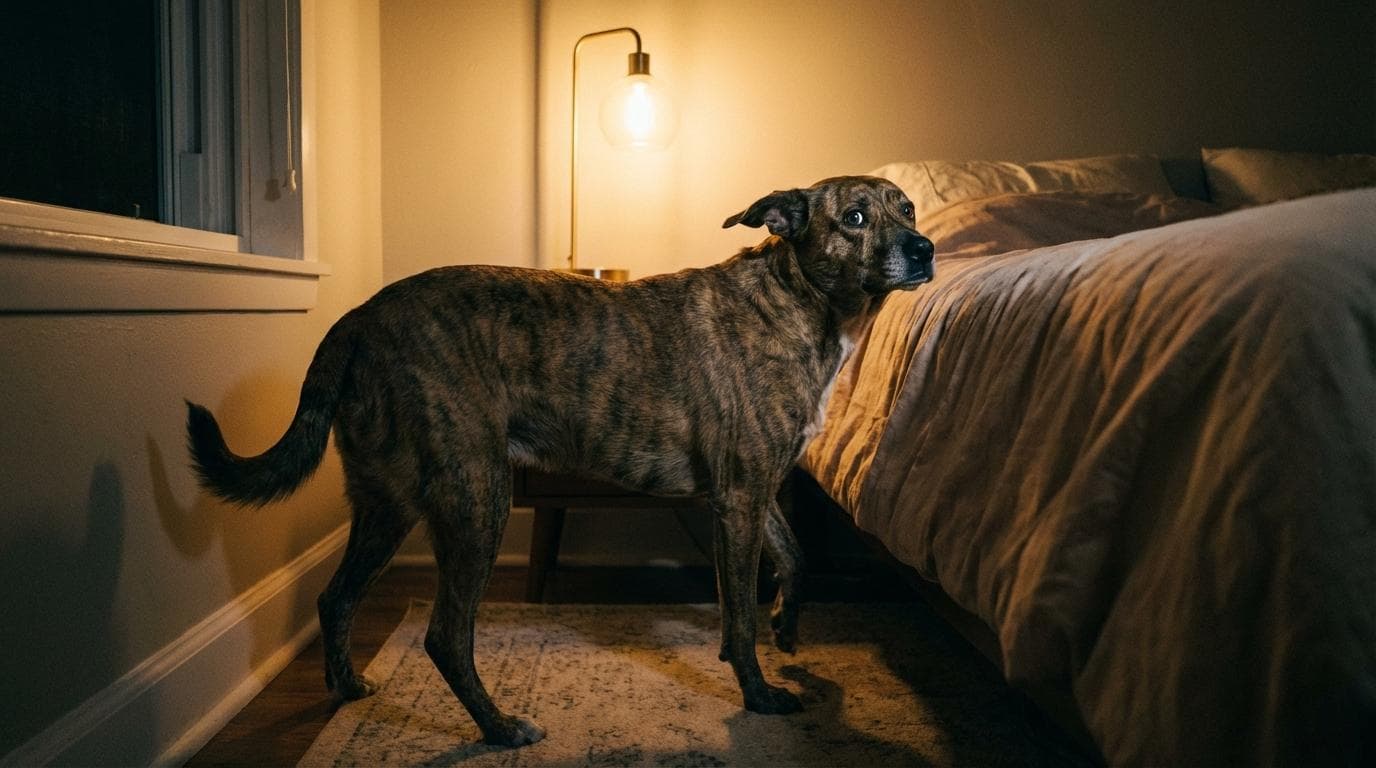
It's 2 AM and your dog is pacing again. They circle the bedroom, pant loudly, whine at the door, climb on and off the bed, maybe scratch at the carpet. You've let them out — they don't need to go. You've fed them — they're not hungry. You've tried ignoring it, scolding it, and sleeping through it. Nothing works, and you're both exhausted.
Nighttime anxiety in dogs is more common than most owners realize, and it's one of the most disruptive behavioral issues because it directly impacts your sleep, your patience, and your ability to function the next day. When you're running on three hours of sleep, your tolerance for your dog's daytime behaviors drops too, creating a cascade of frustration that affects your entire relationship.
The good news: nighttime anxiety has identifiable causes, and once you understand what's driving your dog's restlessness, the solutions are straightforward.
Why Dogs Get Anxious at Night
Nighttime strips away the distractions that keep anxiety at bay during the day. The house is quiet, the family is still, and the environmental stimulation that occupied your dog's brain drops to near zero. For dogs who are already anxious, this creates a void where worry rushes in.
Separation Anxiety After Dark
If your dog sleeps in a different room than you, their nighttime restlessness may be a form of separation anxiety. Dogs with the Velcro Shadow behavioral pattern are particularly susceptible — these dogs organize their entire existence around proximity to their person, and being separated at night feels genuinely threatening to them.
Signs that separation is the issue: your dog settles immediately when allowed in your bedroom, they scratch or whine at closed doors, or they follow you from room to room during the day and simply can't tolerate physical distance.
Hypervigilance and Guarding Behavior
Some dogs can't settle at night because they're on patrol. Every sound — a car door, a possum on the roof, the house settling — triggers alertness and investigation. These dogs often position themselves near doors or windows and may bark at sounds you can't even hear.
This is particularly common in dogs with guardian or territorial behavioral patterns. They've assumed responsibility for the household's safety, and nighttime, when the world is full of unfamiliar sounds and the family is vulnerable, is when they feel that responsibility most acutely.
Insufficient Physical or Mental Stimulation
A dog who hasn't burned enough physical or mental energy during the day will have energy left over at night. This isn't anxiety per se — it's restlessness from unmet needs — but it can look identical to anxiety, especially in high-energy breeds or young dogs. The pacing, the inability to settle, the attention-seeking behavior — all can stem from a dog who simply wasn't tired enough when bedtime arrived.
Pain or Medical Issues
Restlessness at night can also signal physical discomfort. Arthritis pain often worsens after a day of activity and is more noticeable when the dog tries to lie still. Gastrointestinal discomfort, urinary issues, and cognitive dysfunction in senior dogs can all cause nighttime pacing and restlessness.
If the nighttime anxiety appeared suddenly or is accompanied by changes in appetite, mobility, or bathroom habits, a veterinary visit should be your first step before assuming the cause is behavioral.
Building a Nighttime Routine That Works
Dogs thrive on predictability. A consistent pre-bed routine signals to your dog's nervous system that it's time to wind down, the same way a bedtime routine helps children transition to sleep.
The Evening Wind-Down
Start reducing stimulation 60-90 minutes before bedtime. Lower the lights, reduce noise, stop high-energy play. Take your dog for a calm, boring walk — not an exciting exploration, but a predictable route where they can empty their bladder and process the day's remaining mental energy through gentle sniffing.
When you return, offer a calming activity. A stuffed Kong, a lick mat with peanut butter, or a gentle chew provides the repetitive oral activity that naturally lowers arousal in dogs. Licking and chewing release endorphins and activate the parasympathetic nervous system — the "rest and digest" mode that counteracts anxiety.
The Sleeping Environment
Where your dog sleeps matters more than most owners realize.
- Proximity: If your dog shows signs of separation-related anxiety, allowing them to sleep in your bedroom (on a dog bed, not necessarily your bed) often resolves the nighttime restlessness entirely. You're not "giving in" — you're addressing the root cause.
- White noise: A fan or white noise machine masks the environmental sounds that trigger hypervigilant dogs. This is one of the simplest and most effective interventions for dogs who react to nighttime noises.
- Crate training: For some dogs, a properly introduced crate provides a sense of security — a den where they can truly relax because the boundaries are defined. This works best for dogs who are already crate-trained and view the crate positively. Forcing a crate on an anxious dog who hasn't been gradually acclimated will make things worse.
- Temperature: Dogs are sensitive to temperature changes. An anxious dog who is also too warm will be doubly unable to settle. Ensure the sleeping area is cool and well-ventilated.
Daytime Adjustments That Fix Nighttime Problems
Nighttime anxiety is often a symptom of what's happening — or not happening — during the day.
- Exercise timing: Finish vigorous exercise at least 2-3 hours before bedtime. Exercise too close to bed raises arousal levels and makes settling harder.
- Mental enrichment: A dog who has been mentally engaged during the day settles faster at night. Puzzle toys, training sessions, sniff walks, and scent games tire the brain in ways that physical exercise alone cannot.
- Nap management: Paradoxically, dogs who don't nap enough during the day often can't settle at night. Overtired dogs become hyperaroused, just like overtired toddlers. If your dog is unable to rest during the day, address that first.
When to Seek Professional Help
Nighttime anxiety that doesn't improve with environmental management and routine changes may benefit from professional intervention. A veterinary behaviorist can assess whether medication might help your dog's baseline anxiety level, making behavioral interventions more effective. Anti-anxiety medication for dogs is not a failure — it's a tool that can give your dog enough emotional bandwidth to actually learn new coping skills.
Signs that professional help is warranted include destructive behavior during the night, self-harm (excessive licking or chewing), inability to settle even with you present, or nighttime anxiety that has worsened despite consistent intervention.
Understanding Your Dog's Full Pattern
Nighttime anxiety rarely exists in isolation. The dog who paces at night usually shows anxiety in other contexts too — during departures, in new environments, during storms, or when routine changes. Understanding the complete behavioral pattern helps you address the root cause rather than treating each symptom individually.
Take the free Dog Archetype Quiz to identify your dog's behavioral archetype and get a personalized plan that addresses nighttime anxiety as part of your dog's complete behavioral profile.