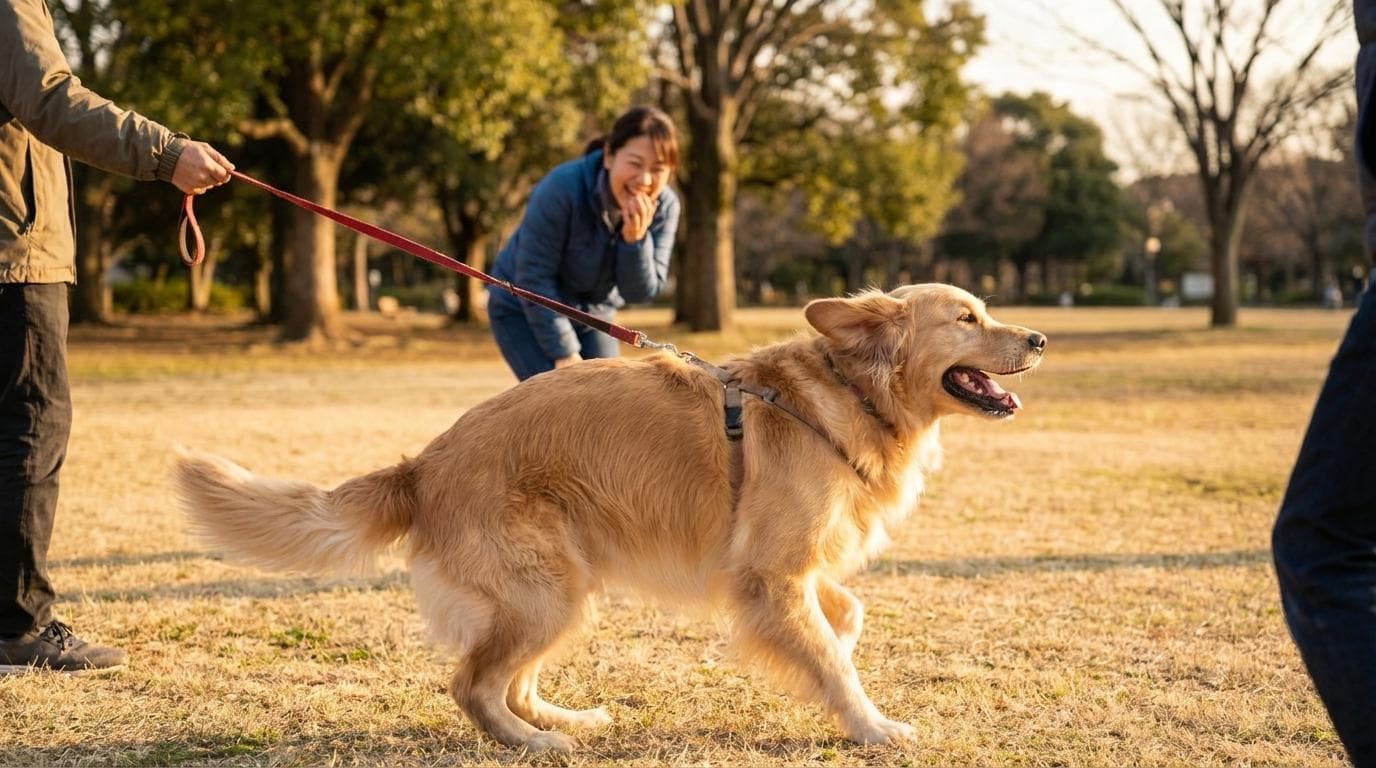
Your Lab isn't being rude — they're overwhelmed with excitement. Here's what's actually driving the behavior and how to fix it for good.
You open the front door and your golden Labrador launches skyward. Your guest takes a paw to the chest. Coffee spills. You apologize for the hundredth time this month.
If lab jumping on people is a recurring scene in your home, you're not alone. Labradors consistently rank among the most enthusiastic greeters in the dog world, and while their exuberance is part of what makes them so lovable, it can also make daily life exhausting — and even dangerous around children or elderly visitors.
Here's what's actually driving the behavior, and what a real labrador training plan looks like.
Why Lab Jumping on People Is So Common
Labradors were bred for generations to work closely alongside humans — retrieving game, checking in constantly with their handler, staying attuned to every emotional signal their person sends. That deep-wired people orientation is a Lab's greatest strength. It's also what makes lab jumping on people so predictable.
When your Lab jumps, they're not being dominant. They're overwhelmed with joy. In dog social etiquette, greeting another dog involves nose-to-face contact. When your Lab tries to greet a human, they're following the same instinct — going for the face, which happens to be five feet in the air. Jumping is the only solution their brain can compute.
Labs also mature slowly. The puppy who jumped because it was cute at eight weeks is now 70 pounds and still running the same greeting software. The behavior hasn't changed — only the impact.
The Frustrated Greeter Archetype and Labrador Training
Labs that can't stop jumping typically fall into what's called the Frustrated Greeter archetype. These dogs are intensely social with an almost overwhelming drive to connect with everyone they meet. Their reactivity isn't fear-based or aggression-based — it's pure, unrefined excitement with no productive outlet.
Hallmarks of a Frustrated Greeter include pulling hard toward strangers and friends alike on walks, whining or barking when they spot a familiar face, jumping on everyone including you after a two-minute absence, difficulty holding a sit while someone approaches, and calming down almost immediately once contact is made.
If that sounds familiar, the jumping isn't a dominance problem. It's a self-regulation problem. Your Lab has more excitement than they know what to do with, and no one has shown them a better outlet.
Why Stop Dog Jumping Advice Often Backfires
Here's where well-meaning owners go wrong: they respond to the jump.
It doesn't matter whether you push the dog off, knee them in the chest, yell down, or turn your back. If any of those responses result in your dog getting attention — even negative attention — from you or your guest, the behavior gets reinforced. Labradors are social animals. Negative attention still registers as interaction, which is exactly what they wanted.
Inconsistency compounds the problem. If jumping gets your Lab ignored 90 percent of the time but earns them a big excited greeting even once, that intermittent reinforcement makes the behavior remarkably durable. Slot machines work on the same principle — your Lab will keep trying because sometimes it pays off.
The stop dog jumping approach that actually works isn't about punishing the jump. It's about making calm behavior the only path to what your Lab wants.
Step 1: Choose the Incompatible Behavior
Decide what your Lab should do instead of jumping. The most reliable choice is a four-paws-on-the-floor sit. A sit is physically incompatible with jumping — your dog cannot do both at once. This becomes your north star for every greeting.
Step 2: Withdraw Attention Precisely and Consistently
From this point forward, whenever your Lab jumps, turn your back, cross your arms, and give no eye contact. Wait for all four paws to hit the floor. The moment they land, turn around, crouch down, and give calm praise or a treat.
Timing is everything. You're not rewarding not jumping — you're rewarding the moment of stillness. Practice this until your Lab starts offering a sit the second you walk in, because they've learned that's the only thing that works.
Step 3: Run Controlled Arrival Repetitions
Most jumping happens at the door. Practice structured repetitions: walk in, ignore any jumping completely, wait for four paws on the floor or a spontaneous sit, then reward immediately and warmly. Walk back out. Pause five seconds. Repeat.
Ten to fifteen repetitions in a session. This is repetitive for you but exactly the kind of structured rehearsal that rewires a Lab's greeting response over time.
Step 4: Add a Formal Sit Cue
Once your Lab reliably offers a sit at the door unprompted, start cueing it proactively. As you approach, say sit before the jump happens. Reward the sit with the greeting they want — which means you can now use petting, eye contact, and your excited voice as the reward itself.
This is powerful for labrador training because you're not removing joy from the greeting. You're inserting a brief moment of impulse control before it happens.
Step 5: Generalize with Guests
This is where most training plans stall. Everything your Lab learned with you needs to be relearned with new people, because dogs don't generalize well across contexts.
Brief every visitor before they come in. No eye contact if the dog jumps. Turn away, wait for four paws, then greet. Most people will cooperate when you explain: she's in training — if you can just turn your back if she jumps, you'll get a much better greeting out of her. Give guests that context and most will be happy to help.
Step 6: Use Leash Management as a Bridge
If your Lab is large or the jumping is unsafe around specific visitors — children, elderly guests, or people carrying things — use a leash for managed greetings while training is ongoing. Loop the leash under your foot so they can't physically jump. Ask for a sit. Release when they're calm. Use the leash as a physical management tool while the behavioral training catches up.
Common Mistakes to Avoid
Kneeing in the chest can injure the dog and often accidentally becomes a play signal for a Lab. Holding their paws up is something many Labs enjoy, so it can inadvertently reinforce jumping. Yelling or scolding provides the attention your Lab is seeking. Allowing jumping sometimes — just when you're in a good mood or wearing old clothes — is the single biggest reason stop dog jumping training fails. Inconsistency teaches your dog that persistence pays off.
How Long Does This Take?
For a young Lab with consistent owners and cooperative guests, meaningful improvement typically appears within two to four weeks. Full reliability — your Lab automatically sits for every greeting, including excitable strangers — usually takes two to three months.
Older Labs with a long history of jumping may take longer, but they can absolutely change. The habit is more ingrained, not the dog. Stay consistent and stay patient.
Your Lab Isn't the Problem
Jumping Labs aren't bad dogs. They're enthusiastic, deeply social animals who haven't been shown a better way to express all that feeling. The behavior is completely normal — and completely trainable. What it requires is a clear, consistent alternative and an owner willing to practice it even when it's inconvenient.
Your Lab wants to greet you. They want to greet everyone. Give them a way to do it that works for both of you.
Take our free 2-minute Dog Archetype Quiz to find out exactly which behavioral archetype is driving your Lab's behavior — and get a personalized training plan built around how your dog actually thinks.