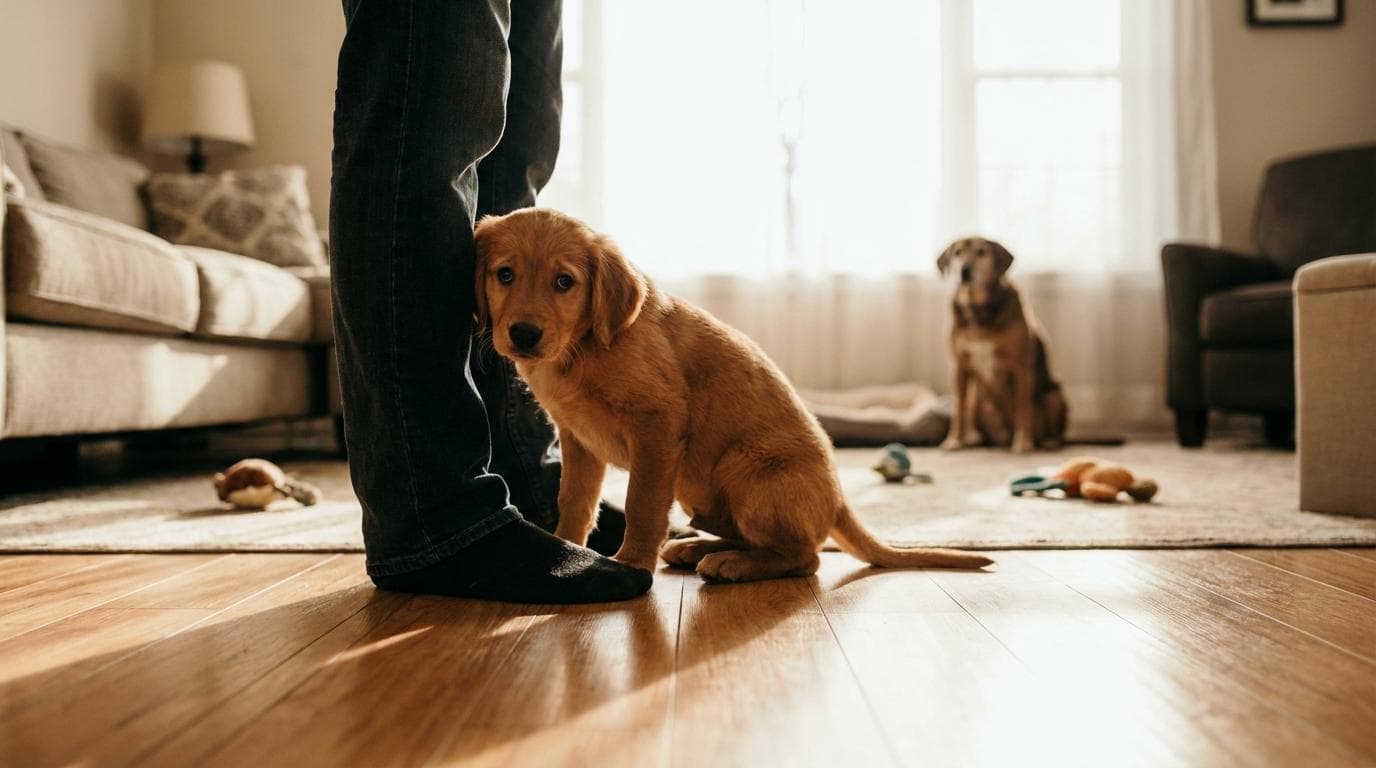
Last week your puppy bounded up to every stranger, played with every dog, and explored every new environment with tail-wagging confidence. This week they're cowering behind your legs, barking at the neighbor they've met twenty times, and refusing to walk past a trash can that wasn't there yesterday.
You haven't done anything wrong. Your puppy is going through a fear period — a normal, predictable developmental stage that every dog experiences. But how you respond during these windows can permanently shape your dog's adult behavior, for better or worse.
What Are Fear Periods?
Fear periods are developmental stages during which puppies become temporarily hypersensitive to novel or startling stimuli. During these windows, experiences that would normally be processed as neutral or mildly interesting can instead create lasting fear associations.
Think of it as the brain's safety software updating. During a fear period, the puppy's developing nervous system is re-calibrating its threat assessment system. Stimuli that were previously classified as "safe" get re-evaluated, and the threshold for triggering a fear response drops significantly.
This isn't a flaw in development — it's a survival mechanism. In the wild, young canids who became more cautious at certain developmental stages were more likely to survive. The puppy who fearlessly approached everything at 8 weeks needed to develop some wariness by adolescence, or they'd walk right up to a predator.
When Fear Periods Happen
Dogs typically go through two major fear periods, though the timing varies by individual and breed. Larger breeds tend to experience fear periods later than smaller breeds.
First Fear Period: 8-11 Weeks
This coincides with the age when many puppies go to their new homes, which is both unfortunate and important to understand. The puppy is processing the enormous change of leaving their mother and littermates while simultaneously going through a period of heightened fear sensitivity.
During this window, a single traumatic experience can create a lasting phobia. A puppy who is roughly handled by a child at 9 weeks may develop a lifelong fear of children. A puppy who has a painful experience at the vet at 10 weeks may become vet-phobic. The experiences during this period carry disproportionate emotional weight.
Second Fear Period: 6-14 Months
The second fear period is broader, more variable, and often more confusing for owners because it happens after months of the puppy seeming completely fine. Owners who did everything right during socialization are blindsided when their 8-month-old suddenly refuses to enter the pet store they've visited weekly since puppyhood.
This period coincides with adolescence and the associated hormonal changes. The puppy's brain is literally reorganizing, and behaviors that were previously stable can temporarily destabilize. Some dogs go through this period mildly — a few days of unusual wariness — while others experience weeks of pronounced fearfulness.
How to Recognize a Fear Period
The hallmark of a fear period is a sudden, seemingly unexplained change in your puppy's confidence level. Signs include:
- Startling at stimuli they previously ignored
- Barking or growling at familiar people, dogs, or objects
- Refusing to approach things they used to approach willingly
- Increased clinginess or hiding behavior
- Body language shifts: tucked tail, flattened ears, dilated pupils, trembling
- Hesitation at thresholds (doorways, stairs) they previously navigated easily
What to Do During a Fear Period
Do: Be Your Puppy's Safe Base
Your puppy needs to know that you're safe and reliable during this confusing time. When they look to you for reassurance, provide it. Pet them calmly, speak in a relaxed tone, and let them know through your body language that everything is fine. Contrary to outdated advice, comforting a scared puppy does not "reinforce" fear. You cannot reinforce an emotion. You can only reinforce a behavior.
Do: Maintain Normal Routine
Don't withdraw from the world. Continue your regular walks, visits to familiar places, and interactions with known people and dogs. Avoiding everything your puppy finds scary during a fear period teaches them that those things really are worth avoiding. Normal routine provides evidence that the world hasn't actually changed.
Do: Let Your Puppy Set the Pace
If your puppy doesn't want to approach something, don't force it. Let them observe from a distance they're comfortable with. Toss treats near (not on) the scary object. Let them choose to investigate when they're ready. Many puppies will approach on their own if given time and space.
Don't: Force Exposures
This is the most common and most damaging mistake. "Flooding" — forcing a puppy to confront something scary under the theory that they'll "get used to it" — can create permanent fear associations during a fear period. The puppy who is dragged toward the scary dog during a fear window doesn't learn that dogs are safe. They learn that their owner doesn't protect them and dogs are even scarier than they thought.
Don't: Introduce Major New Experiences
A fear period is not the time to take your puppy to their first fireworks show, their first crowded festival, or their first encounter with a skateboard. Save novel experiences for when your puppy is back in a confident phase. Maintain what's familiar and avoid adding new potential fear triggers.
Don't: Punish the Fear
Scolding your puppy for barking at the scary thing, jerking their leash when they refuse to move, or using any form of correction during a fear response adds pain and fear to an already fearful experience. This is how dogs develop lifelong behavioral problems. The Anxious Guardian behavioral pattern often has roots in fear periods that were handled with punishment rather than support.
How Long Fear Periods Last
The first fear period typically lasts 1-3 weeks. The second can last 1-4 weeks, sometimes appearing in waves over several months. During adolescence especially, you might see your puppy's confidence come and go, with good days and bad days, before stabilizing into their adult temperament.
If fearfulness persists beyond 4-6 weeks without improvement, or if it's severe enough to significantly impact your puppy's quality of life, consult a veterinary behaviorist. What started as a normal fear period may have been compounded by traumatic experiences or may indicate a more enduring anxiety disorder.
The Long-Term Impact
Fear periods are temporary, but their effects can be permanent if handled poorly. A puppy who has a severely negative experience during a fear period — a dog attack, a painful fall, a terrifying noise — may carry that fear for life. Conversely, a puppy whose fear period is navigated with patience, support, and gentle exposure will typically emerge with their confidence restored and resilient adult behavior patterns established.
The behavioral archetype your adult dog eventually settles into is influenced by both genetics and these critical developmental windows. Take the free Dog Archetype Quiz to understand your dog's behavioral profile and learn whether their current patterns reflect a fear period that left lasting impressions.