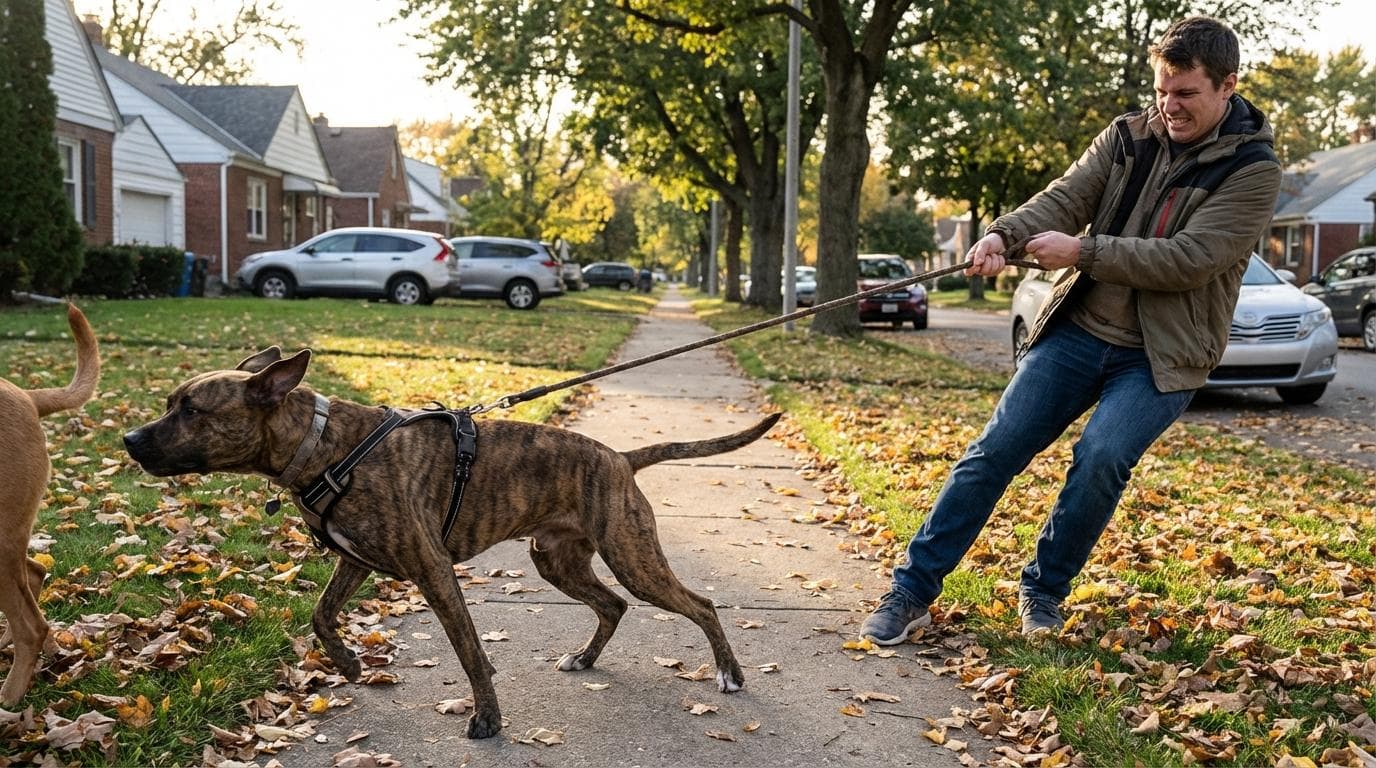
It’s a scenario you know all too well: You’re enjoying a peaceful walk with your beloved canine companion when, seemingly out of nowhere, another dog or person appears. Suddenly, your calm companion transforms. They lunge, bark, growl, pull frantically, and generally make a scene, leaving you feeling embarrassed, frustrated, and utterly confused.
You might find yourself wondering, "Why is my dog reactive on leash?" You're not alone. This is one of the most common and challenging behaviors dog owners face. Many people assume their dog is aggressive, trying to dominate, or just being a "bad dog." But what if we told you it's almost certainly not what you think?
Leash reactivity is rarely about aggression in the way most people perceive it. Instead, it’s a complex mix of emotions like fear, anxiety, over-excitement, and profound frustration, all amplified by the restrictive nature of a leash. Your dog isn't trying to be difficult; they're trying to communicate, often desperately, that they are overwhelmed and struggling to cope. Understanding the true root cause is the first, most crucial step towards helping your dog find peace on walks and transforming your shared experience.
What Exactly Is Leash Reactivity?
Let’s start by defining what we mean when we talk about leash reactivity. It’s a term used to describe a dog’s exaggerated, often intense, reaction to specific triggers while on a leash. These triggers can vary widely but commonly include other dogs, unfamiliar people, cyclists, joggers, skateboards, cars, or even squirrels.
When your dog is reactive, you might observe a range of behaviors:
* Barking and Growling: Often loud, intense, and persistent.
* Lunging and Pulling: Your dog might pull with all their might towards or away from the trigger, often with their body stiff or tense.
* Whining and Frantic Movements: Some dogs might whine incessantly, spin in circles, or jump up and down.
* Hackles Raised: The hair on their back might stand up, indicating arousal or fear.
* Fixated Stare: They might lock their gaze onto the trigger, unable to break eye contact.
These reactions are almost always an attempt by your dog to either create distance from something they perceive as a threat (fear) or to get closer to something they desperately want to interact with (frustration). The leash, while essential for safety, removes your dog’s natural ability to choose their own escape route or approach strategy, forcing them into a heightened state of arousal and often leading to an explosive display.
Why Is My Dog Reactive on Leash? Unpacking the Real Reasons
It’s easy to jump to conclusions when your dog displays such intense behaviors. But let's dig deeper into the most common underlying reasons for dog reactive on leash behaviors.
It's Not Always Aggression: Fear and Anxiety
This is perhaps the most common misconception. Many reactive dogs are not aggressive in the true sense of the word; they are simply afraid. Imagine being strapped to a chair and suddenly seeing something that terrifies you approaching. Your natural instinct would be to flee, but you can't. Your next instinct might be to make a loud noise or thrash around to make the scary thing go away. This is very similar to what a fearful dog experiences.
When your dog sees a trigger they are afraid of, their primitive "fight or flight" response kicks in. Because the leash restricts their ability to "flight" (run away), they often resort to "fight" (barking, lunging, growling) as a last resort to increase distance and make the perceived threat disappear. They're essentially saying, "Go away! You're too close!"
This kind of fear-based reactivity is often seen in dogs who are naturally timid, had negative experiences in the past, or weren't adequately socialized as puppies. If your dog is a Fearful Reactor Archetype, they might be particularly prone to this, always on guard and seeing potential threats where others see friends. Their body language often gives it away – ears back, tail tucked, rigid body, or even trembling, right before the explosion.
Frustration: "I Can't Get To It (Or Away From It)!"
Another major driver of leash reactivity is frustration. This manifests in a couple of key ways:
Frustration to Greet: Some dogs desperately want* to greet other dogs or people but are restrained by the leash. They might pull, whine, and lunge because they're over-excited and simply can't handle the barrier between them and what they want. They might have a history of pushy or inappropriate greetings, or they just lack the impulse control to wait patiently. This is a classic trait of the Frustrated Greeter Archetype, who often means well but expresses their enthusiasm poorly.
* Frustration from Lack of Control: Dogs are natural explorers and hunters. Being on a leash often prevents them from engaging in natural behaviors like sniffing freely, chasing a squirrel, or marking territory. This constant suppression of natural instincts can build up, leading to an explosive release of pent-up energy and frustration when a trigger appears.
Imagine being excited to meet a friend, but someone holds you back and says, "Not yet!" repeatedly. Eventually, you might get agitated and yell. Your dog feels similarly, but with much higher stakes from their perspective.
Over-stimulation and Lack of Impulse Control
Some dogs are simply more sensitive to their environment or have higher energy levels. An Overstimulated Athlete Archetype, for instance, thrives on activity and can easily become over-aroused by the sights, sounds, and smells of the world. For these dogs, the urban environment can be a sensory overload.
When combined with a lack of impulse control training, this over-stimulation can quickly escalate into a reactive outburst. They see something exciting (or even just novel) and simply can't regulate their response. The leash then becomes a physical barrier that prevents them from processing that excitement in a healthy way, leading to a meltdown. They haven't learned how to manage their impulses, focus on you amidst distractions, or calm themselves down.
Genetics and Early Experiences
While training plays a huge role, some dogs are predisposed to certain behaviors due to genetics. Certain breeds might have stronger guarding instincts (like the Anxious Guardian or Under-socialized Protector Archetypes), higher prey drives, or more sensitive temperaments.
Furthermore, a dog's early experiences profoundly shape their reactivity. A lack of proper socialization during their critical puppyhood window (before 16 weeks) can lead to fear or discomfort around novel stimuli. Conversely, negative experiences, such as being attacked by another dog or startled by a loud noise, can create lasting fear associations, turning previously neutral triggers into sources of intense anxiety.
Leash Pressure and Handler Influence
Believe it or not, your actions can inadvertently contribute to your dog's leash reactivity. A tight leash, for example, can create tension that communicates anxiety to your dog. It can also physically restrict them, making them feel even more trapped and defensive. If you become tense or anxious when you see an approaching trigger, your dog will pick up on your stress, confirming their own suspicions that there is something to worry about. This creates a vicious cycle where your fear feeds their fear, and vice versa.
Practical Strategies for Reactive Dog Training
Now that you understand why your dog might be reactive, let's talk about how to help them. Reactive dog training requires patience, consistency, and a commitment to positive reinforcement methods. Remember, you're not punishing your dog for reacting; you're helping them feel safer and more comfortable in the world.
1. Observe and Identify Your Dog's Triggers and Threshold
The first step is to become a detective. What exactly triggers your dog? Is it all dogs, only certain breeds, specific people (men, children), bikes, or something else? Keep a journal to note:
* The trigger: What was it?
* Distance: How far away was it when your dog reacted?
* Intensity of reaction: Mild whine, full-blown lunge?
* Context: Time of day, location, your mood.
This helps you identify your dog's "threshold" – the distance at which they can still notice the trigger but remain calm and responsive to you. Training always starts below this threshold.
2. Management: Preventing Rehearsal of Reactive Behaviors
While you're working on training, your primary goal is to prevent your dog from practicing their reactive behaviors. Every time they react, the behavior gets stronger.
* Avoid Triggers: During initial training, choose quiet walking routes, walk at off-peak hours, or drive to secluded areas.
* Create Distance: If you see a trigger approaching, cross the street, turn around, or step behind a parked car or bush.
* Optimize Walking Gear: A front-clip harness or a head halter can give you more control and reduce pulling without causing pain. Avoid retractable leashes, which teach dogs to pull and offer poor control.
3. Counter-Conditioning and Desensitization (Changing Emotions)
This is the cornerstone of reactive dog training. You want to change your dog's emotional response to the trigger from negative (fear/frustration) to positive.
Counter-Conditioning: Pair the trigger with something wonderful. Every time your dog sees a trigger at a distance where they are calm*, immediately give them a high-value treat (chicken, cheese, hot dogs). The goal is for them to eventually associate "trigger = yummy food" instead of "trigger = scary/frustrating."
* Desensitization: Gradually expose your dog to the trigger at increasingly closer distances, always staying below their threshold. Start far away, reward, then slowly decrease the distance over many sessions.
A great game for this is "Look at That" (LAT):
1. Your dog sees a
Further Reading
For more expert guidance on this topic, check out these trusted resources: